
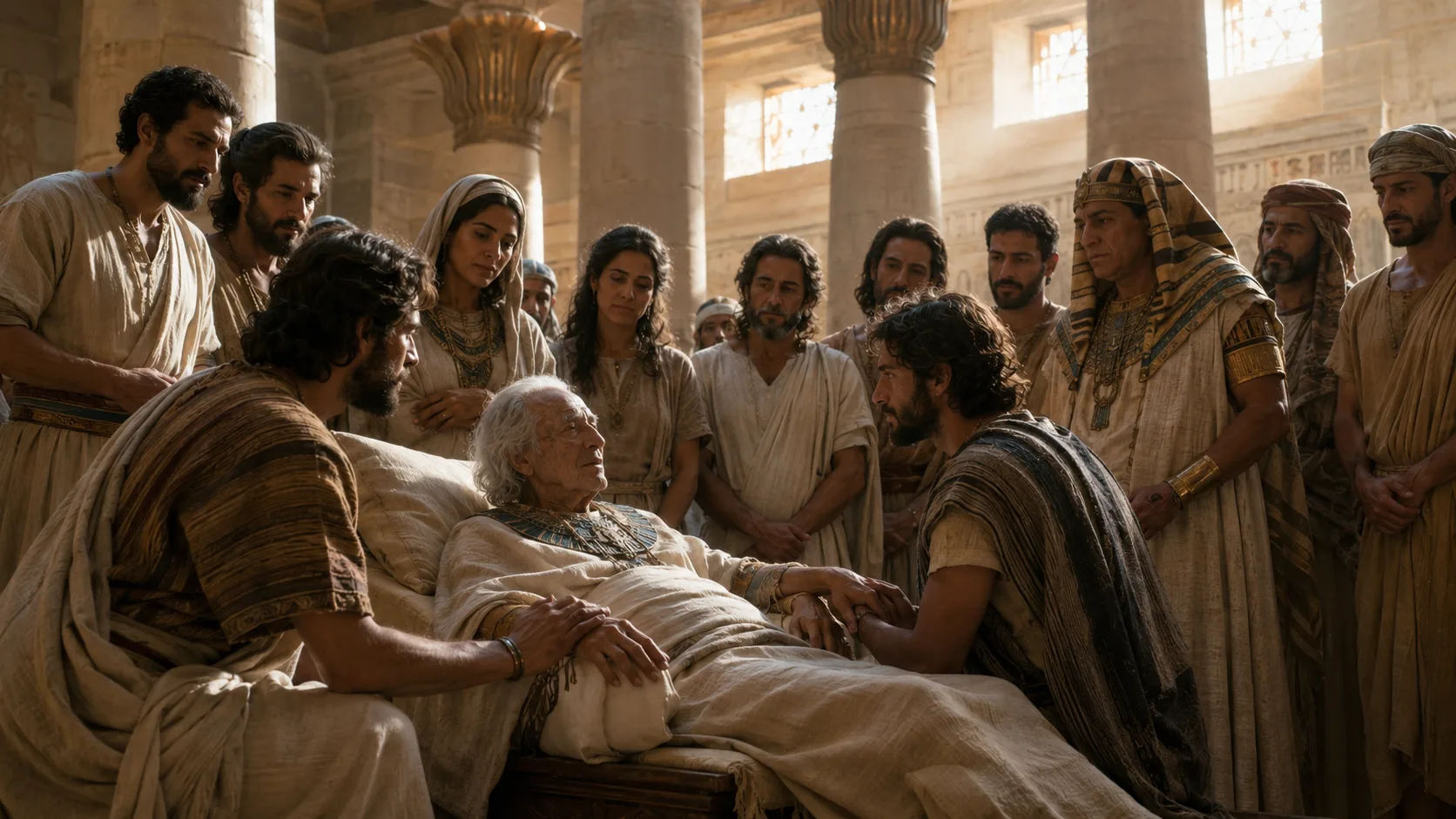
Genesis 50
Fulfilling a solemn promise to his father, Joseph leads a grand Egyptian funeral procession to bury Jacob in Canaan, later extending gracious forgiveness to his fearful brothers and anchoring his dying faith in God's certain promise to bring Israel out of Egypt.
Genesis 50 brings the magnificent book of Genesis to a majestic and poignant close. Situated immediately after the death of Jacob and his prophetic blessings in chapters 48 and 49, this final chapter records the closing acts and deaths of the two great patriarchs of this narrative era: Jacob and Joseph. The narrative opens with the solemn and elaborate Egyptian embalming of Jacob and a massive, official state funeral procession that crosses back into Canaan, honoring the patriarch's dying wish to rest in the cave of Machpelah.
The literary structure moves deliberately from the royal Egyptian mourning and the burial at Atad and Hebron, to the return to Egypt and the rising anxiety of Joseph’s brothers who fear long-delayed vengeance. It then highlights Joseph’s profound theological response—famously declaring that human evil was overridden by divine providence for good—and concludes with Joseph's long life, his final prophetic declaration regarding the Exodus, a binding oath concerning his bones, and his death at one hundred ten years old in a coffin in Egypt. Culturally and historically, the passage reflects ancient Egyptian mortuary practices, royal state escorts, mourning customs, and the patriarchal focus on ancestral burial sites. The theological weight centers on the complete triumph of forgiveness over vengeance, the supreme comfort of God's overarching providence, and an unwavering faith that looks forward to the ultimate fulfillment of the covenant promises in the land of Canaan.
1. The Death, Embalming, and Funeral of Jacob
Genesis 50:1–14
1 Then Joseph fell on his father’s face, wept on him, and kissed him. 2 Joseph commanded his servants, the physicians, to embalm his father; and the physicians embalmed Israel. 3 Forty days were used for him, for that is how many days it takes to embalm. The Egyptians wept for Israel for seventy days.
4 When the days of weeping for him were past, Joseph spoke to Pharaoh’s staff, saying, “If now I have found favor in your eyes, please speak in the ears of Pharaoh, saying, 5 ‘My father made me swear, saying, “Behold, I am dying. Bury me in my grave which I have dug for myself in the land of Canaan.” Now therefore, please let me go up and bury my father, and I will come again.’”
6 Pharaoh said, “Go up, and bury your father, just like he made you swear.”
7 Joseph went up to bury his father; and with him went up all the servants of Pharaoh, the elders of his house, all the elders of the land of Egypt, 8 all the house of Joseph, his brothers, and his father’s house. Only their little ones, their flocks, and their herds, they left in the land of Goshen. 9 Both chariots and horsemen went up with him. It was a very great company. 10 They came to the threshing floor of Atad, which is beyond the Jordan, and there they lamented with a very great and severe lamentation. He mourned for his father seven days. 11 When the inhabitants of the land, the Canaanites, saw the mourning in the floor of Atad, they said, “This is a grievous mourning by the Egyptians.” Therefore its name was called Abel Mizraim, which is beyond the Jordan. 12 His sons did to him just as he commanded them, 13 for his sons carried him into the land of Canaan, and buried him in the cave of the field of Machpelah, which Abraham bought with the field, as a possession for a burial site, from Ephron the Hittite, near Mamre. 14 Joseph returned into Egypt — he, and his brothers, and all that went up with him to bury his father, after he had buried his father.
Commentary
Deep Grief and Embalming: Overcome with sorrow, Joseph falls upon his father's face, weeping and kissing him, before ordering the royal Egyptian physicians to embalm Jacob, a process requiring forty days of specialized care and seventy total days of national mourning.
Requesting Royal Leave: Through Pharaoh's court officials, Joseph respectfully requests permission to fulfill his father's solemn oath by traveling to Canaan to bury him, promising to return immediately afterward.
Pharaoh’s Immediate Consent: Demonstrating deep respect for Joseph and honoring the oath, Pharaoh grants unconditional permission for the journey.
A Grand State Procession: An impressive and massive contingent escorts the funeral cortege, including Pharaoh's servants, the elders of Egypt's house, national leaders, Joseph's entire household, and his brothers, complete with chariots and horsemen.
The Seven-Day Lamentation at Atad: Stopping at the threshing floor of Atad beyond the Jordan, the company conducts a severe seven-day mourning period, catching the attention of local Canaanites who name the site Abel Mizraim ("mourning of the Egyptians").
Burial in Machpelah: Fulfilling their exact instructions, Jacob's sons carry his body into Canaan and lay him to rest in the ancestral cave of Machpelah alongside Abraham, Sarah, Isaac, Rebekah, and Leah.
Insight: Honoring our parents and keeping sacred commitments to the dying are profound acts of legacy, respect, and enduring faith.
2. The Brothers’ Fear and Joseph’s Forgiveness
Genesis 50:15–21
15 When Joseph’s brothers saw that their father was dead, they said, “It may be that Joseph will hate us, and will fully pay us back for all the evil which we did to him.” 16 They sent a message to Joseph, saying, “Your father commanded before he died, saying, 17 ‘You shall tell Joseph, “Now please forgive the disobedience of your brothers, and their sin, whether they did evil to you.”’ Now, please forgive the disobedience of the servants of the God of your father.” Joseph wept when they spoke to him. 18 His brothers also went and fell down before his face; and they said, “Behold, we are your servants.”
19 Joseph said to them, “Don’t be afraid, for am I in the place of God? 20 As for you, you meant evil against me, but God meant it for good, to save many people alive, as is happening today. 21 Now therefore don’t be afraid. I will provide for you and your little ones.” He comforted them, and spoke kindly to them.
Commentary
Lingering Guilt and Fear: Following Jacob's death, guilt resurfaces among the brothers, who fear that Joseph only restrained his vengeance out of respect for their father and will now punish them for their past betrayal.
A Mediation Message: The brothers dispatch a formal message to Joseph, appealing to a command allegedly given by Jacob before his death to forgive their sin and rebellion.
Joseph’s Emotional Response: Deeply moved by their lack of trust and ongoing fear, Joseph weeps upon hearing their plea, grieved that they still doubted his heart.
Total Surrender: The brothers humble themselves completely, coming before Joseph, falling to the ground, and offering themselves as his permanent servants.
Disclaiming Vengeance: Joseph reassures them instantly, asking the profound rhetorical question, "Am I in the place of God?"—disclaiming any right to act as a judge over their lives.
The Grand Theology of Providence: Joseph delivers one of the most famous theological statements in Scripture: "As for you, you meant evil against me, but God meant it for good, to save many people alive, as is happening today."
Reassurance and Provision: Dispelling all their lingering terror, Joseph promises to sustain them and their little ones, comforting them and speaking words of profound kindness.
Insight: Genuine forgiveness does not harbor secret retaliation; it surrenders judgment to God and replaces fear with generous, comforting provision.
3. Joseph’s Final Days and the Oath of the Bones
Genesis 50:22–26
22 Joseph lived in Egypt, he, and his father’s house. Joseph lived one hundred ten years. 23 Joseph saw Ephraim’s children to the third generation. The children also of Machir, the son of Manasseh, were born on Joseph’s knees. 24 Joseph said to his brothers, “I am dying, but God will surely visit you, and bring you up out of this land to the land which he swore to Abraham, to Isaac, and to Jacob.” 25 Joseph took an oath from the children of Israel, saying, “God will surely visit you, and you shall carry up my bones from here.” 26 So Joseph died, being one hundred ten years old, and they embalmed him, and he was put in a coffin in Egypt.
Commentary
A Long and Blessed Life: Joseph continues living in Egypt surrounded by his extended family, reaching the significant age of one hundred ten years.
Generations of Descendants: Enjoying the blessing of longevity, Joseph lives to see Ephraim’s great-grandchildren and bounces the descendants of Machir upon his knees.
The Prophetic Declaration of Exodus: As his life draws to a close, Joseph gathers his family and issues a firm prophecy: "God will surely visit you, and bring you up out of this land to the land which he swore to Abraham, to Isaac, and to Jacob."
Demanding an Oath Concerning His Bones: Like his father before him, Joseph makes the children of Israel swear a binding oath that when God visits them, they will carry his bones out of Egypt.
Death and Coffin in Egypt: Joseph passes away at one hundred ten years old; his body is embalmed according to Egyptian custom, and he is placed in a coffin, waiting for the day of deliverance.
A Closing Note of Hope: The book of Genesis closes not with a grave in Canaan, but with a coffin in Egypt—a silent, enduring testament of faith that Egypt is not their permanent home and that God's promises will unfailingly come to pass.
Insight: True faith looks past the borders of our temporary exile and trusts that God will fulfill His promises in His perfect timing.
Theological Significance
The Triumphant Reign of Divine Providence: The chapter anchors its theological weight in the truth that God sovereignly overrules human evil, weaving sin and betrayal into a tapestry of universal salvation.
The Power of Unconditional Forgiveness: Joseph models divine grace by refusing vengeance and offering complete restoration to those who wronged him.
Covenant Continuity and Hope: The dying words of both Jacob and Joseph emphasize that Israel's identity is rooted in the promised land, looking forward to the future Exodus.
Faith Preserved in a Coffin: Placing Joseph in a coffin rather than burying him in Canaan serves as a constant, physical reminder to succeeding generations that God's covenant is active and a return is guaranteed.
Major Themes
Egyptian mortuary customs and grand state funerals
Guilt, fear, and emotional healing
The supremacy of divine providence over human evil
Unconditional forgiveness and kindness
Longevity, family blessing, and legacy
Deathbed faith and the certainty of the Exodus
Practical Applications
Release Unresolved Guilt and Fear: Stop living in fear of past mistakes or anticipating punishment when God has already offered grace and forgiveness.
View Hardships Through the Lens of Providence: When others treat you maliciously, trust that God is powerful enough to take that evil and redeem it for good in your life.
Extend Radical Forgiveness: Follow Joseph's example by comforting those who have hurt you, replacing judgment with kindness and provision.
Live with an Eye on Eternity: Do not become so attached to temporary comforts in foreign environments that you lose sight of your ultimate spiritual home and God's eternal promises.
Final Insight
As the book of Genesis draws to a close with a coffin resting quietly in Egypt, it leaves behind a powerful declaration of resilient faith: human evil can try to derail God's plans, but divine providence always turns malice into mercy. From a pit in Dothan to a coffin in Egypt, Joseph's life stands as an eternal witness that God is always working behind the scenes to save, redeem, and bring His people home.
Possible Sermon Titles from the Chapter
You Meant Evil Against Me, But God Meant It for Good
A Coffin in Egypt: Faith That Looks Beyond Exile
The Healing Power of Forgiveness
When God Overrules Human Malice
