
Genesis 11
God frustrates humanity’s proud attempt to build a unified empire at Babel by confusing their language and scattering them across the earth, shifting redemptive focus from scattered nations to the chosen family line of Abram.
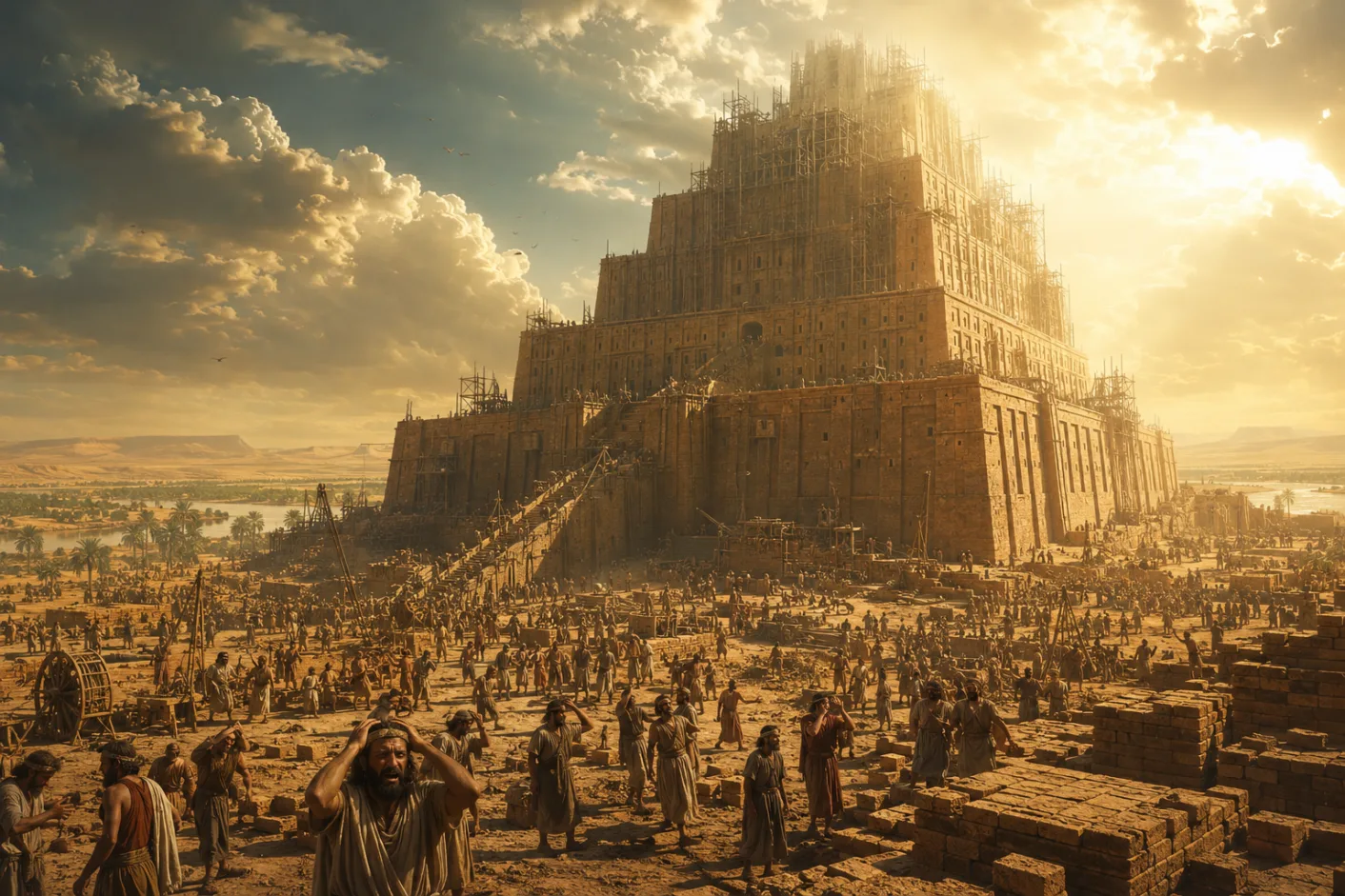
Following the broad table of nations outlined in Genesis 10, Genesis 11 brings the primeval history of Genesis 1–11 to its climactic turning point. The chapter opens with humanity's collective attempt to establish absolute autonomy, self-preservation, and fame through the construction of the Tower of Babel. In response to this pride, Yahweh personally intervenes to judge human ambition, introducing linguistic diversity and dispersing the population across the face of the globe.
Literally and structurally, the passage shifts from a dramatic narrative of global judgment to a focused, linear genealogy tracing the ancestral line from Shem down to Terah and his family. This transition is essential: while human pride builds an empire that collapses under divine judgement, God quietly prepares a single, obscure family through whom He will bless all scattered nations. The chapter concludes by introducing Abram, his barren wife Sarai, and their initial migration from Ur of the Chaldees to Haran, setting the stage for the call of Abraham and the patriarchal narrative.
1. The Rebellion of Babel and Divine Intervention
Genesis 11:1–9
1 The whole earth was of one language and of one speech. 2 As they traveled east, they found a plain in the land of Shinar, and they lived there. 3 They said to one another, “Come, let’s make bricks, and burn them thoroughly.” They had brick for stone, and they used tar for mortar. 4 They said, “Come, let’s build ourselves a city, and a tower whose top reaches to the sky, and let’s make a name for ourselves, lest we be scattered abroad on the surface of the whole earth.”
5 The LORD came down to see the city and the tower, which the children of men built. 6 The LORD said, “Behold, they are one people, and they all have one language, and this is what they begin to do. Now nothing will be withheld from them, which they intend to do. 7 Come, let’s go down, and there confuse their language, that they may not understand one another’s speech.” 8 So the LORD scattered them abroad from there on the surface of all the earth. They stopped building the city. 9 Therefore its name was called Babel, because there the LORD confused the language of all the earth. From there, the LORD scattered them abroad on the surface of all the earth.
Commentary
A Single Language and Collective Purpose: The chapter opens by noting that post-Flood humanity shared "one language and of one speech." This linguistic unity provided an opportunity for cooperative obedience, but humanity instead used it to organize a collective rebellion against God's command to fill the whole earth (Genesis 1:28; Genesis 9:1).
Technological Innovation and Human Autonomy: Traveling eastward to the plain of Shinar (Babylonia), the people developed kiln-fired bricks and bitumen mortar. This technological breakthrough enabled ambitious urban construction projects in a region lacking natural building stone, fostering a sense of self-sufficiency independent of God.
The Motives of Pride and Fear: Humanity's goal was twofold: "let’s make a name for ourselves" (self-exaltation and fame) and "lest we be scattered" (fear-driven self-preservation). Their monument—likely a stepped ziggurat tower designed to reach the heavenly realm—represented a proud attempt to bridge heaven and earth on human terms.
Divine Irony and Inspection: Verse 5 presents sharp literary irony: while humans believed their tower reached to the sky, Yahweh had to "come down" to see this tiny achievement. No matter how imposing human monuments appear, they remain minuscule before the absolute majesty of God.
Judgment Through Confusion: In verse 7, God speaks within the divine counsel ("Come, let's go down"), confusing human speech so that cooperation instantly broke down. The name Babel plays on the Hebrew word balal (meaning "to confuse"), while echoing the Babylonian meaning of "gate of the gods." God transformed their symbol of ultimate glory into a global proverb of confusion.
Insight: Human pride attempts to construct security and glory independent of God, but divine power effortlessly transforms human arrogance into confusion.
2. The Lineage of Promise from Shem to Terah
Genesis 11:10–26
10 This is the history of the generations of Shem: Shem was one hundred years old when he became the father of Arpachshad two years after the flood. 11 Shem lived five hundred years after he became the father of Arpachshad, and became the father of more sons and daughters.
12 Arpachshad lived thirty-five years and became the father of Shelah. 13 Arpachshad lived four hundred three years after he became the father of Shelah, and became the father of more sons and daughters.
14 Shelah lived thirty years, and became the father of Eber. 15 Shelah lived four hundred three years after he became the father of Eber, and became the father of more sons and daughters.
16 Eber lived thirty-four years, and became the father of Peleg. 17 Eber lived four hundred thirty years after he became the father of Peleg, and became the father of more sons and daughters.
18 Peleg lived thirty years, and became the father of Reu. 19 Peleg lived two hundred nine years after he became the father of Reu, and became the father of more sons and daughters.
20 Reu lived thirty-two years, and became the father of Serug. 21 Reu lived two hundred seven years after he became the father of Serug, and became the father of more sons and daughters.
22 Serug lived thirty years, and became the father of Nahor. 23 Serug lived two hundred years after he became the father of Nahor, and became the father of more sons and daughters.
24 Nahor lived twenty-nine years, and became the father of Terah. 25 Nahor lived one hundred nineteen years after he became the father of Terah, and became the father of more sons and daughters.
26 Terah lived seventy years, and became the father of Abram, Nahor, and Haran.
Commentary
The Toledot of Shem: The phrase "This is the history of the generations of Shem" introduces ten post-Flood generations linking Shem directly to Terah and Abram. This deliberate genealogy contrasts sharply with the judgment at Babel, demonstrating that God was actively keeping His covenant promises alive through a specific, preserved family line.
Gradual Decline in Human Lifespans: A comparison between the lifespans of the pre-Flood patriarchs in Genesis 5 and the post-Flood patriarchs in Genesis 11 shows a marked decrease in longevity. Shem lived 600 years, Eber lived 464 years, Peleg lived 239 years, and Terah lived 205 years. This systematic decline illustrates the enduring physiological and environmental impacts of the Fall and the Flood.
The Ancestral Anchor of Eber: The genealogy explicitly traces the descent through Eber, highlighting the lineage from which the Hebrew people (Ivri) derived their historical name and identity.
Focusing on the Final Trio: Like the genealogy of Genesis 5 (which concluded with Noah's three sons: Shem, Ham, and Japheth), this list concludes with Terah fathering three sons: Abram, Nahor, and Haran. The narrative narrative structure intentionally narrows down from the entire scattered world to one specific family in Mesopotamia.
Insight: While human nations build temporal empires destined to fall, God quietly and faithfully preserves His chosen line of promise across every generation.
3. The Family of Terah and the Departure from Ur
Genesis 11:27–32
27 Now this is the history of the generations of Terah. Terah became the father of Abram, Nahor, and Haran. Haran became the father of Lot. 28 Haran died in the land of his birth, in Ur of the Chaldees, while his father Terah was still alive. 29 Abram and Nahor married wives. The name of Abram’s wife was Sarai, and the name of Nahor’s wife was Milcah, the daughter of Haran, who was also the father of Iscah. 30 Sarai was barren. She had no child. 31 Terah took Abram his son, Lot the son of Haran, his son’s son, and Sarai his daughter-in-law, his son Abram’s wife. They went from Ur of the Chaldees, to go into the land of Canaan. They came to Haran and lived there. 32 The days of Terah were two hundred five years. Terah died in Haran.
Commentary
The Family Setting and Early Tragedy: The family history of Terah is marked by loss and difficulty. Haran died prematurely in "Ur of the Chaldees" (an influential urban and religious center in southern Mesopotamia), leaving his son Lot in the care of his extended family.
The Mention of Sarai's Barrenness: Verse 30 contains a major theological detail: "Sarai was barren. She had no child." Humanly speaking, the line of promise reached an absolute dead end in Sarai's womb. This detail sets up the central tension of the Abrahamic narrative: God's promise of a great nation requires a miraculous divine intervention over human helplessness.
The Partial Journey Toward Canaan: Terah gathered his household—including Abram, Sarai, and Lot—and set out from Ur with the intention of going to the land of Canaan. However, when they reached Haran (a major trade center in northern Mesopotamia), they settled there rather than completing the journey.
Death in Haran: The chapter closes with the death of Terah in Haran at 205 years old. This death marks the end of an old era and sets the stage for Abram to step out in radical obedience to Yahweh's call in Genesis 12.
Insight: God frequently positions His greatest redemptive promises directly against the backdrop of human impossibility and incomplete journeys.
Theological Significance
The Judgment of Human Pride: Babel stands as the ultimate Old Testament paradigm of human pride attempting to achieve security, unity, and fame without God. God actively opposes self-exalting structures.
Sovereignty Over Language and Culture: The diversity of human languages and ethnicities is not an accidental evolutionary development, but a direct result of divine intervention designed to restrain collective human evil.
The Contrast Between Babel and the Kingdom: Babel represents humanity's attempt to make a name for itself through force and ambition, whereas God promises to make Abram’s name great through grace and blessing (Genesis 12:2).
The Faithfulness of the Covenant Line: Amid widespread global idolatry and dispersion, God's providence kept an unbroken lineage from Shem to Abram, ensuring that the promised seed of the woman (Genesis 3:15) would arrive.
Divine Power Over Human Barrenness: The introduction of Sarai's barrenness highlights that salvation is entirely a work of divine grace. Where human nature offers no hope, God brings forth life and blessing.
Major Themes
Human pride and divine judgment
The sovereignty of God over human history and geography
The origin of linguistic and cultural dispersion
Preservation of the redemptive lineage
Human helplessness versus divine promise
Partial obedience and transition
Practical Applications
Examine Your Motivations: Guard against building personal "towers of Babel"—pursuing career, wealth, or status merely to "make a name for yourself" rather than glorifying God.
Value Cultural Diversity: Recognize that linguistic and cultural differences among people reflect God's sovereign governance over history, treating every ethnic group with dignity and respect.
Trust God in Seasons of Barrenness: When facing situations that appear humanly impossible or dead, trust that God specializes in bringing life out of hopelessness.
Finish the Journey: Avoid stopping halfway in your spiritual calling as Terah did in Haran; press forward in full obedience to where God leads you.
Seek Unity in the Holy Spirit: Recognize that while human pride divided humanity at Babel, God reunites believers across every language and nation through the Holy Spirit (Acts 2:1–11; Revelation 7:9).
Final Insight
Genesis 11 exposes the profound contrast between human ambition and divine providence. At Babel, united humanity attempted to storm heaven to build a lasting name, only to end in confusion and global dispersion. Yet, out of the scattered ruins of human pride, God quietly called an obscure man with a barren wife from a pagan land, setting in motion a redemptive plan that would ultimately bless every family on earth through Jesus Christ.
Possible Sermon Titles from the Chapter
The Day the Tower Fell
Three Lessons from Babel's Ruin
From Scattered Nations to a Chosen Name
