
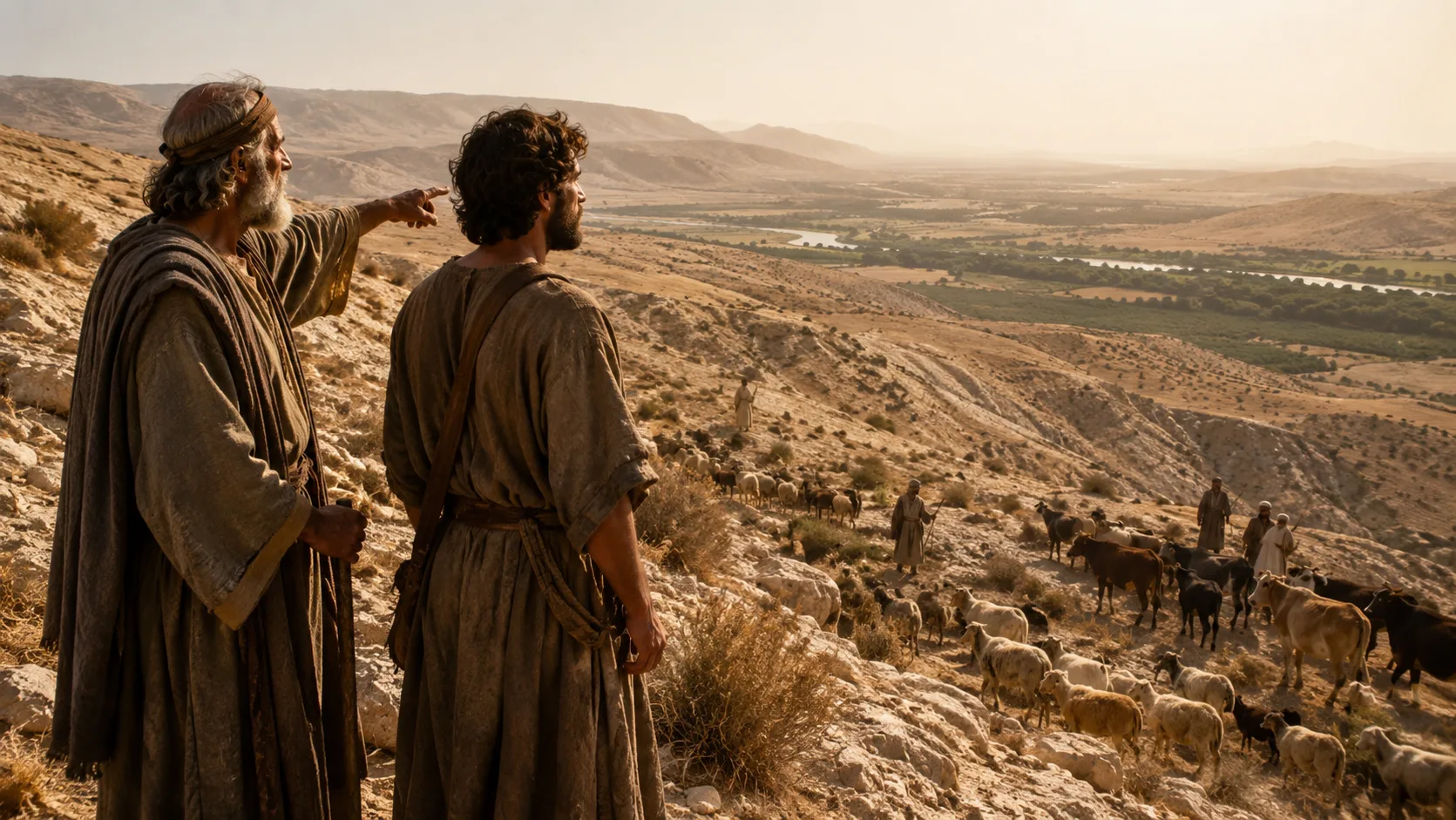
Genesis 13
After returning from Egypt to his altars in Canaan, Abram resolves a wealth-driven conflict with his nephew Lot through sacrificial peacemaking, prompting Yahweh to reaffirm His covenant promises of endless offspring and territory.
Following the spiritual detour and divine deliverance in Egypt recorded in Genesis 12, the patriarch Abram returns to the Promised Land to re-establish his worship and covenant walk with God. Genesis 13 marks a critical stage of spiritual maturity and testing for Abram. As both Abram and his nephew Lot return with vast herds and acquired wealth, the physical resources of the central Canaanite ridge prove insufficient to sustain their combined households. The resulting friction between their herdsmen creates a potential crisis that threatens both family unity and their public witness before the surrounding Canaanite and Perizzite inhabitants.
Literally and structurally, the chapter unfolds across three distinct narrative movements: Abram’s repentance and return to his original altar between Bethel and Ai (verses 1–4), the conflict over land and Abram’s generous peacemaking proposal that leads to Lot’s self-serving choice of the Jordan Plain (verses 5–13), and Yahweh’s magnificent covenant renewal, where He commands Abram to view and walk through the expansive land promised to his descendants (verses 14–18). Theologically, the chapter contrasts walking by sight with walking by faith, demonstrating that genuine trust in God’s providence frees the believer to practice humility, generosity, and peace.
1. The Return from Egypt to the Altar
Genesis 13:1–4
1 Abram went up out of Egypt—he, his wife, all that he had, and Lot with him—into the South. 2 Abram was very rich in livestock, in silver, and in gold. 3 He went on his journeys from the South as far as Bethel, to the place where his tent had been at the beginning, between Bethel and Ai, 4 to the place of the altar, which he had made there at the first. There Abram called on the LORD’s name.
Commentary
Ascending from Egypt: The text records that Abram "went up out of Egypt" into the Negev ("the South"). In biblical geography, leaving Egypt for the Promised Land is consistently described as going "up," symbolic of returning to the place of divine appointment and covenant relationship after a season of compromise.
The Weight of Wealth: Verse 2 notes that Abram was "very rich" (kaved me'od, literally "very heavy") in livestock, silver, and gold. While this wealth was partially acquired through his ordeal in Egypt (Genesis 12:16), it brought new administrative burdens and social friction that would immediately test his character.
Returning to the Beginning: Abram retraced his steps to the exact location between Bethel and Ai where he had initially pitched his tent. True repentance often involves returning to the point of spiritual departure, re-establishing core habits of faith, and seeking God at the place of initial calling.
Renewing Public Worship: At the altar (mizbeach) he had previously built, Abram "called on the LORD’s name" (qara be-shem YHVH). This public invocation signifies a complete restoration of fellowship, as Abram cast off his fear-driven reliance on Egyptian schemes to place his life once again under Yahweh’s sovereign care.
Insight: Real spiritual recovery begins when we return to the altar of true worship and surrender our self-reliance back to God.
2. Strife and Sacrificial Peacemaking
Genesis 13:5–9
5 Lot also, who went with Abram, had flocks, herds, and tents. 6 The land was not able to bear them, that they might live together; for their possessions were so great that they couldn’t live together. 7 There was strife between the herdsmen of Abram’s livestock and the herdsmen of Lot’s livestock. The Canaanites and the Perizzites lived in the land at that time. 8 Abram said to Lot, “Please, let there be no strife between you and me, and between your herdsmen and my herdsmen; for we are relatives. 9 Isn’t the whole land before you? Please separate yourself from me. If you go to the left hand, then I will go to the right. Or if you go to the right hand, then I will go to the left.”
Commentary
The Strain of Material Abundance: Both Abram and Lot possessed vast "flocks, herds, and tents," to the extent that the pastureland and water wells could not sustain them both. This detail illustrates that material prosperity, if not managed with wisdom and humility, can easily become a source of division rather than blessing.
Internal Conflict in a Hostile Environment: The text specifically mentions that "The Canaanites and the Perizzites lived in the land at that time." Internal squabbling between God's worshippers in full view of pagan onlookers threatened to damage their testimony and expose their vulnerable households to external exploitation.
Initiating Peace Through Humility: As the elder patriarch and the explicit recipient of God's covenant promises, Abram possessed the moral and social right to claim first choice of the land. Instead, he initiated peace, appealing to their family bond ("for we are relatives," literally anshim achim anachnu, "we are men who are brothers").
Voluntary Renunciation of Rights: Abram generously offered Lot first choice of the entire landscape: "If you go to the left hand, then I will go to the right." Abram's willingness to yield his rights proved that his security was anchored in Yahweh's promise, not in securing the most fertile pastureland for himself.
Insight: Faith in God’s absolute provision enables believers to lay down personal rights and actively pursue peace in family and community.
3. Walking by Sight: Lot’s Self-Serving Choice
Genesis 13:10–13
10 Lot lifted up his eyes, and saw all the plain of the Jordan, that it was well-watered everywhere, before the LORD destroyed Sodom and Gomorrah, like the garden of the LORD, like the land of Egypt, as you go to Zoar. 11 So Lot chose the Plain of the Jordan for himself. Lot traveled east, and they separated themselves from one another. 12 Abram lived in the land of Canaan, and Lot lived in the cities of the plain, and moved his tent as far as Sodom. 13 Now the men of Sodom were exceedingly wicked and sinners against the LORD.
Commentary
The Trap of Outer Appearances: Lot "lifted up his eyes, and saw" the lush Jordan Valley. He evaluated his options purely through physical sight and economic potential, choosing what appeared best for immediate commercial success without considering moral or spiritual consequences.
Comparison to Eden and Egypt: The narrative compares the well-watered valley to both "the garden of the LORD" (Eden) and "the land of Egypt." This double comparison carries deep literary irony: the valley offered agricultural paradise like Eden, yet held the spiritual enticements and hidden bondage of Egypt.
Separation from the Covenant Line: By choosing the eastern plain, Lot voluntarily separated himself from Abram and the boundary of Canaan proper. His choice took him away from the altar and the primary sphere of covenant blessing.
Gradual Moral Compromise: Verse 12 tracks Lot's spiritual decline: he first settled among "the cities of the plain," then "moved his tent as far as Sodom," and eventually sat in its city gate (Genesis 19:1). The text solemnly warns that "the men of Sodom were exceedingly wicked and sinners against the LORD," setting up the impending judgment of Genesis 19.
Insight: Making major life choices based solely on material gain without evaluating spiritual environment inevitably leads to compromise and loss.
4. Covenant Reaffirmation and the Altars of Hebron
Genesis 13:14–18
14 The LORD said to Abram, after Lot was separated from him, “Now, lift up your eyes, and look from the place where you are, northward and southward and eastward and westward, 15 for I will give all the land which you see to you and to your offspring forever. 16 I will make your offspring as the dust of the earth, so that if a man can count the dust of the earth, then your offspring may also be counted. 17 Arise, walk through the land in its length and in its width; for I will give it to you.” 18 Abram moved his tent, and came and lived by the oaks of Mamre, which are in Hebron, and built an altar there to the LORD.
Commentary
Divine Speech Following Human Surrender: Significantly, Yahweh spoke to Abram after Lot had departed. Once Abram had willingly yielded the fertile valley and separated from strife, God stepped in to expand his spiritual vision and reaffirm His promises.
Lifting Eyes in Faith: While Lot lifted his own eyes in selfish ambition (verse 10), God commanded Abram to "lift up your eyes, and look" in every direction. What Abram surrendered in humility, God granted back to him in boundless divine proportion.
Everlasting Land and Innumerable Offspring: God promised to give the entire visible horizon to Abram and his offspring "forever" (ad-olam). Furthermore, He promised to make his descendants "as the dust of the earth" (ka-aphar ha-aretz), an emphatic metaphor for an uncountable, miraculous lineage.
Claiming the Land by Faith: God instructed Abram to "Arise, walk through the land." In ancient Near Eastern legal custom, walking through a property represented taking formal, symbolic possession of an inheritance. Abram was invited to claim by faith what he did not yet own physically.
Establishing Worship at Hebron: Abram moved his encampment southward to the "oaks of Mamre, which are in Hebron," building yet another altar to Yahweh. Hebron (meaning "fellowship" or "association") became his long-term residence, marked by deep communion with God and public worship.
Insight: When we surrender our earthly ambitions to honor God, He opens our eyes to eternal promises that far exceed anything we gave up.
Theological Significance
Repentance as Restoration: Abram's return from Egypt to his altar between Bethel and Ai illustrates that true repentance restores fellowship with God, placing the believer back on the path of covenant obedience.
Faith Versus Sight: Genesis 13 presents a classic biblical study in contrasts between walking by faith (Abram) and walking by sight (Lot). Lot chose visual abundance that led to moral ruin, while Abram accepted temporary limitation and received eternal inheritance (2 Corinthians 5:7).
God’s Unconditional Covenant Initiative: Yahweh's appearance in verses 14–17 confirms that the covenant depends on His sovereign grace. God rewards Abram’s faithful self-denial by expanding the promises of land and offspring.
The Witness of Christian Unity: Abram’s concern over strife in the presence of the Canaanites underscores that unity among God's people is essential for preserving a compelling public witness before an unbelieving world (John 17:21).
Major Themes
Repentance and spiritual restoration
Faith versus sight in decision-making
Peacemaking and yielding personal rights
The dangers of worldly compromise
Covenant promises of land and offspring
Pilgrim lifestyle and continuous worship
Practical Applications
Return to Spiritual Basics: When you realize you have drifted into worldly self-reliance, return immediately to prayer, Scripture, and the worship community where your faith was first nurtured.
Prioritise Peace Over Personal Rights: Be willing to yield financial advantages, preference, or status in order to resolve conflicts and preserve unity within your family and church.
Evaluate Opportunities Beyond Surface Value: Before accepting a promotion, relocation, or business partnership, look past financial perks to assess its potential impact on your family’s spiritual life and moral character.
Trust God to Guard Your Future: Refuse to grab greedily for success; rest in the knowledge that God is fully capable of providing for you when you seek His kingdom first (Matthew 6:33).
Actively Walk in God’s Promises: Step out in courageous, daily obedience, claiming by faith the spiritual victory, peace, and grace that God has guaranteed in His Word.
Final Insight
Genesis 13 reveals that true greatness lies not in grabbing the best of this world, but in trusting the God who owns all things. While Lot looked on the lush plains of Sodom and chose according to the flesh, Abram looked to Yahweh and yielded his rights for the sake of peace. In response, God met His faithful servant, expanding his vision to encompass an everlasting inheritance. When we surrender our selfish choices at the altar of worship, God faithfully secures our future beyond all that we could ask or imagine.
Possible Sermon Titles from the Chapter
Returning to the First Altar
The Danger of Looking Toward Sodom
Three Marks of a Sacrificial Peacemaker
