
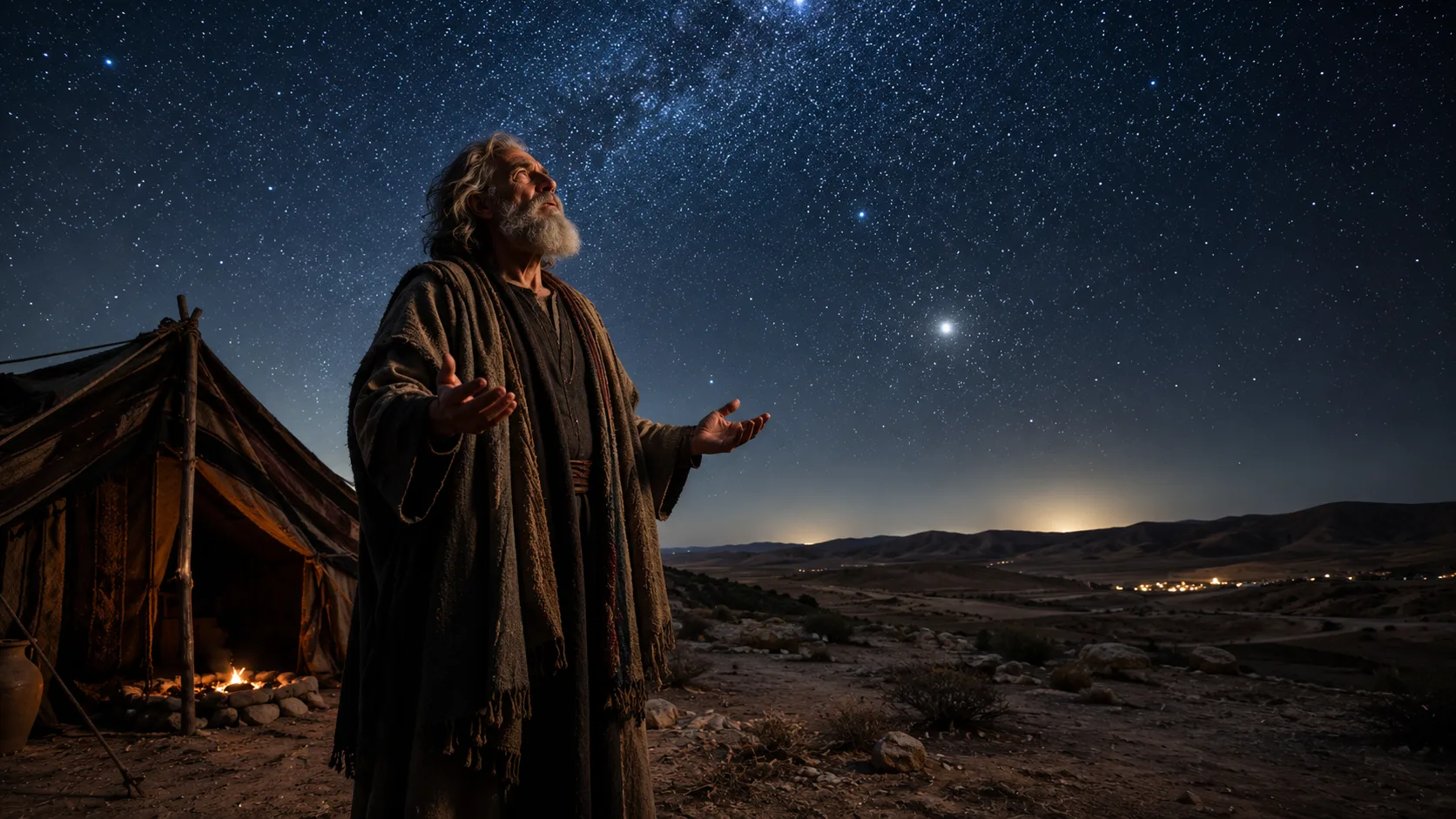
Abraham
The Father of Many Nations and Paradigm of Faith
Abraham is the grand patriarch of Israel, chosen by God to receive an everlasting covenant that promised a multiplying lineage, a sacred homeland, and ultimate global blessing, demonstrating a life justified by faith.
Abraham stands as one of the most foundational and monumental figures in the entire biblical narrative, revered as the patriarch of the Israelite nation and the spiritual father of all who walk by faith. Called by God out of a pagan homeland, Abraham's life marks the formal initiation of God’s covenantal relationship with a chosen people, through whom the entire world would ultimately be blessed. His journey from the ancient city of Ur to the promised land of Canaan serves as the ultimate paradigm of absolute trust, radical obedience, and enduring hope in the promises of the Almighty.
Throughout his wandering life, Abraham encountered the living God through a series of dramatic personal revelations, establishing altars of worship wherever he pitched his tents. His narratives are not merely historical records of an ancient nomadic chieftain, but theological anchors that define the nature of faith, righteousness, and divine election. By stepping out into the unknown at the command of Yahweh, he broke away from the polytheistic traditions of his ancestors to pioneer a monotheistic legacy that would alter the course of human history.
The pinnacle of Abraham's spiritual journey was tested in the fires of personal sacrifice, most notably when he was asked to surrender the very promise he had waited decades to receive. In every crisis, from international conflicts to deep domestic trials, his life demonstrated a raw, developing faith that was credited to him as righteousness. As the recipient of the unconditional Abrahamic Covenant, his lineage paved the structural framework for the biological arrival of Israel, the prophets, the scriptures, and ultimately, the Messiah Himself.
Name Meaning
The name Abram, which he carried for the first ninety-nine years of his life, originates from the Hebrew roots meaning "exalted father." This initial name carried a poignant irony for most of his life, as he and his wife remained completely childless into their old age, presenting a stark contrast between his public identity and his private reality.
God systematically transformed his identity by changing his name to Abraham, which means "father of a multitude" or "father of many nations." This divine renaming occurred during the formalization of the covenant of circumcision, serving as an unyielding, prophetic guarantee that despite his advanced age and his wife's barrenness, his biological and spiritual descendants would eventually outnumber the stars in the heavens.
Family Background and Lineage
1. The Line of Shem
Abraham was a tenth-generation descendant of Noah through the line of Shem, tracing a lineage that preserved the post-flood knowledge of the true Creator. He was born to Terah in the sophisticated urban center of Ur, growing up alongside his brothers Nahor and Haran, within a family structure that historical scriptures note had slipped into the widespread polytheism of the Mesopotamian region.
2. Marriage to Sarah
He married his half-sister Sarai (later renamed Sarah), whose shared paternal lineage with Abraham created a tight-knit domestic alliance. Sarah was consistently described as a woman of extraordinary physical beauty, yet her structural barrenness remained the defining sorrow and central conflict of their early lives, directly threatening the continuation of their ancestral line.
3. Guardianship of Lot
Following the premature death of his brother Haran in Ur, Abraham took his orphaned nephew Lot into his immediate household. Lot accompanied Abraham throughout his massive migrations across the Fertile Crescent, developing his own extensive wealth and herds under Abraham's patriarchal guidance, which eventually led to territorial conflicts and an amicable separation between their clans.
Historical and Biblical Context
Abraham lived during the Middle Bronze Age, an era characterized by thriving city-states, complex trade routes, and widespread pagan religious systems throughout the Ancient Near East. Ur of the Chaldeans was a highly advanced metropolis dedicated to the worship of the moon god Nanna, featuring grand ziggurats, complex legal codes, and high material wealth.
When Abraham migrated to Canaan, he entered a fragmented geopolitical landscape occupied by various local tribes, including the Canaanites, Perizzites, and Hittites. It was a region devoid of centralized government, where security depended entirely on the size of a chieftain's private militia and alliances with neighboring rulers. Spiritually, the land was dominated by fertility cults and localized deities, making Abraham's exclusive worship of Yahweh a radical, counter-cultural anomaly in the region.
God's Calling
Abraham's definitive spiritual turning point occurred when the glory of God appeared to him, issuing a radical command to abandon his country, his extended family, and his father’s house to journey toward an unidentified land that God would eventually reveal. This call required an absolute severance from his cultural security, economic inheritance, and familial safety networks in exchange for a dynamic relationship with an unseen Deity.
With this command, God issued a multi-layered, unconditional promise: He would transform Abraham into a great nation, bless him extraordinarily, make his name famous, and use him as a universal conduit of divine favor. The ultimate scope of this calling was global and redemptive, declaring that through Abraham's seed, every distinct family group across the face of the earth would eventually experience ultimate blessing.
Major Roles
1. The Covenant Patriarch
Abraham functions as the grand root of the Israelite nation, receiving the foundational promises of land, seed, and blessing that established Israel's distinct identity and purpose.
2. The Intercessor
He acted as a bold mediator before God, famously bargaining for the preservation of righteous souls within the wicked cities of the plain.
3. The Military Commander
When necessity demanded, he assumed the role of a strategic military strategist, mobilizing his private household army to defeat an alliance of foreign kings.
4. The Altar Builder
Throughout his travels, he served as a pioneer of true monotheistic worship, constructing physical altars to claim the pagan landscape in the name of Yahweh.
5. The Prophet
Recognized by contemporary rulers as a man uniquely close to God, he possessed prophetic insight and the authority to pray for the healing and restoration of others.
Appearance and Lifestyle
As a semi-nomadic pastoralist chieftain, Abraham lived a highly active, outdoor lifestyle, residing exclusively in portable goat-hair tents that could be struck and moved according to seasonal grazing needs. He commanded a massive household enterprise, managing hundreds of servants, herdsmen, and vast flocks of sheep, goats, and cattle, alongside significant reserves of silver and gold accumulated through trade and divine favor.
While the biblical text offers no specific details regarding his physical features, it portrays him as a man of formidable physical resilience, capable of leading forced military marches across rugged terrain well into his eighties. His public presence was that of a dignified, honorable prince, commanding deep respect and political deference from local kings, Hittite merchants, and foreign rulers alike.
Character Traits
1. Unwavering Faith
He possessed a profound capacity to believe God’s words against all human probability, trusting in a God who brings life out of dead wombs.
2. Radical Hospitality
Abraham displayed deep warmth and generosity, eagerly rushing to welcome, feed, and refresh weary travelers who approached his tent.
3. Strategic Courage
He demonstrated fierce bravery and swift decisiveness when defending his family, refusing to back down against superior military forces.
4. Magnanimity and Peaceableness
He consistently prioritized relational peace over personal rights, allowing his nephew Lot first choice of the prime grazing lands.
5. Imperfect Human Vulnerability
Under intense pressure, he occasionally succumbed to fear, twice engineering deceptive schemes regarding his wife's identity to protect his own life in foreign territories.
Major Life Events
1. The Migration from Haran
At seventy-five years old, Abraham departed Haran with his wife, nephew, and accumulated possessions, stepping into a lifelong journey of nomadic wandering through Canaan.
2. The Covenant of the Pieces
God formalized His promises through an ancient covenant ritual, passing alone as a smoking oven and flaming torch between divided animal pieces to guarantee the land grant to Abraham's seed.
3. The Birth of Ishmael
Prompted by Sarah's ongoing barrenness, Abraham fathered a son through Hagar, Sarah's Egyptian maidservant, creating complex domestic friction that resonated across generations.
4. The Covenant of Circumcision
At ninety-nine years old, God renewed the covenant, altered his name from Abram to Abraham, and instituted circumcision as the permanent physical sign of the covenant.
5. Intercession for Sodom
Abraham stood boldly before the Lord, engaging in a remarkable, compassionate dialogue to spare the city of Sodom for the sake of a righteous remnant.
6. The Miraculous Birth of Isaac
In fulfillment of God's specific timeline, ninety-year-old Sarah conceived and gave birth to Isaac, the long-awaited child of promise, bringing immense joy to the household.
7. The Offering on Mount Moriah
In the ultimate test of allegiance, Abraham obeyed God's command to offer Isaac as a burnt offering, only to be stopped by the Angel of the Lord when a ram was provided as a substitute.
Major Relationships
Sarah: His loyal partner through decades of wandering, whose shared grief over barrenness and ultimate joy in motherhood anchored the covenant narrative.
Isaac: The miraculous son of his old age, the sole heir of the covenant promises, and the object of his deepest paternal love and ultimate testing.
Lot: His orphaned nephew whom he protected, enriched, and heroically rescued from foreign captivity following a painful territorial separation.
Hagar and Ishmael: His Egyptian concubine and firstborn son, whose eventual expulsion into the wilderness caused Abraham intense personal grief, though God preserved them.
Melchizedek: The mysterious King of Salem and Priest of God Most High, to whom Abraham paid a tenth of all his war spoils in a moment of profound spiritual recognition.
Key Teachings
The narrative of Abraham's life emphasizes:
Righteousness is credited through simple faith in God's promises, long before external rituals are performed
True faith requires a willingness to abandon earthly securities at the command of God
God remains completely faithful to His word, even when fulfillment seems humanly impossible due to age or circumstance
Partial obedience and fear-based deception consistently produce long-term domestic and structural friction
Intercessory prayer possesses immense weight before a just and merciful God
Total surrender of our most precious blessings is the path to discovering God's ultimate provision
Important Biblical Passages
Genesis 12:1-3 - The foundational call of Abram, establishing the core promises of land, nationhood, and global blessing.
Genesis 15:6 - The crucial theological declaration that Abram believed the Lord, and it was counted to him as righteousness.
Genesis 17:1-8 - The formal alteration of his name to Abraham and the introduction of the covenant of circumcision.
Genesis 22:1-18 - The dramatic account of the binding of Isaac on Mount Moriah, revealing Jehovah-Jireh (The Lord Will Provide).
Romans 4:1-5 - Paul's foundational New Testament exposition using Abraham to demonstrate justification by faith apart from legalistic works.
Galatians 3:6-9 - The apostolic confirmation that all who belong to faith are true sons and heirs of Abraham.
Hebrews 11:8-19 - The historical faith hall of fame highlighting Abraham’s obedience in leaving home and offering up Isaac.
Legacy and Impact
The earthly life of Abraham permanently shifted the course of global religious history, serving as the biological and spiritual fountainhead for three of the world's major monotheistic traditions. His absolute trust in a single, personal God laid the theological foundations that shattered the dominant polytheistic paradigms of the ancient world, introducing a revolutionary understanding of faith based on personal relationship rather than ritual manipulation.
Beyond his historical lineage, Abraham's primary legacy is his position as the universal father of all Christian believers. By demonstrating that righteousness is a gift received through faith rather than earned through legalistic achievement, his life serves as the essential baseline for the Gospel of grace. Across thousands of years, his journey continues to inspire millions to step out of their personal comfort zones, trust the unseen promises of God, and live as strangers and pilgrims on the earth.
Symbolism
The Stars and Sand: Represent the limitless, mathematically unquantifiable expansion of Abraham's physical and spiritual descendants across history.
The Split Animals: Symbolize the binding, life-and-death seriousness of God’s self-maledictory oath to fulfill His covenant promises.
The Ram in the Thicket: Represents divine substitutionary atonement, foreshadowing the ultimate sacrifice of Christ on the cross.
The Altar: Symbolizes absolute surrender, devotion, and the public claiming of dark territories for the true living God.
The Circumcision: Represents the permanent cutting away of the flesh, serving as the indelible physical reminder of covenant distinctiveness.
Extra-Biblical References
Ancient historical traditions outside the biblical text provide rich accounts of Abraham's widespread reputation across the ancient world. The first-century Jewish historian Flavius Josephus devotes extensive portions of his Antiquities of the Jews to Abraham, detailing his profound intellect, his introduction of arithmetic and astronomy to the Egyptians, and his philosophical arguments against polytheism based on the orderly nature of the cosmos.
Furthermore, early fragments from the second-century BC historian Eupolemus describe Abraham as an exceptionally wise giant born in Babylonia who lived an honorable life, successfully defeated the Phoenician invaders, and engaged deeply with Egyptian priests. These independent cultural traditions confirm that Abraham was remembered across the ancient Near East not merely as a simple nomad, but as a brilliant, highly influential philosopher-prince who fundamentally altered the intellectual landscape of his time.
Lessons from Abraham's Life
Walking by faith means stepping forward when you only know the Director, not the destination.
God’s delays are never God’s denials; His timing is perfectly calibrated to maximize His ultimate glory.
When we try to manufacture God's promises through human flesh, we create long-term conflict.
True generosity means letting go of the best portion, trusting that God is our ultimate shield and reward.
The things we are most afraid to surrender to God are the very things He wants to bless exponentially.
God looks past our moments of fearful vulnerability to honor the core direction of our faith.
A life marked by regular worship sets an enduring spiritual anchor for the generations that follow.
