
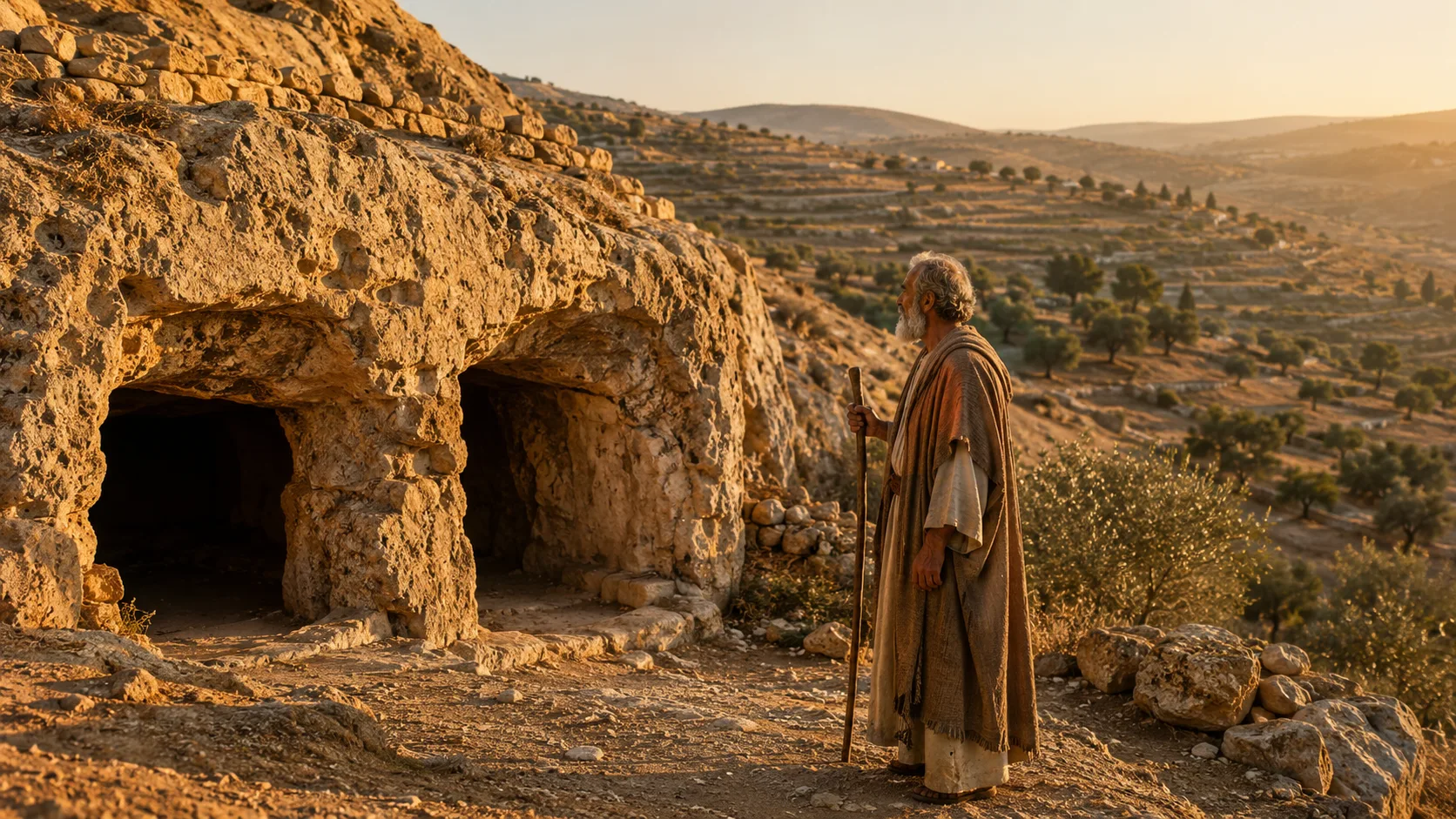
Machpelah
Cave of the Patriarchs
The Cave of the Patriarchs, located in Hebron, is the biblical burial site of Abraham, Sarah, Isaac, Rebecca, Jacob, and Leah. Purchased by Abraham from Ephron the Hittite, it appears primarily in Genesis as a family sepulchre. The site signifies God’s covenant promise regarding the land and anchors the patriarchal narratives in physical reality.
Introduction
The Cave of the Patriarchs, known in Hebrew as Me'arat HaMachpelah (the Cave of Machpelah), holds a profound place in biblical geography and salvation history. First introduced in Genesis 23, the site enters the narrative not as a battlefield or a royal palace, but as a sepulchre—a quiet plot of land secured by Abraham to bury his wife Sarah. Situated near Hebron, one of the oldest continuously inhabited cities in the region, the cave became the final resting place for three generations of patriarchal families. The biblical text records the specific burials of Abraham and Sarah, Isaac and Rebecca, and Jacob and Leah, transforming a simple limestone cavern into a powerful symbol of covenant continuity and rootedness in the Promised Land.
Throughout the biblical record, the acquisition of Machpelah marks a critical turning point. Before this purchase, Abraham and his household lived as resident aliens, possessing no permanent land of their own, despite divine promises. By purchasing the field and the cave from Ephron the Hittite for four hundred shekels of silver, Abraham established a legal, hereditary anchor in Canaan. This transaction ensured that the physical bodies of the patriarchs rested within the land promised to their descendants, serving as a permanent sign of hope during centuries of migration and future Egyptian bondage. The site’s historical and theological gravity extends far beyond its function as a tomb, capturing the essence of ancestral faith and the unbreakable bond between God’s covenant people and the land of promise.
Geographical Location and Description
The Cave of the Patriarchs is located in the ancient city of Hebron, nestled within the southern Judean Hills at an elevation of approximately 930 metres above sea level. This elevated position gives the region a cooler climate and makes it a natural crossroads connecting the coastal plains with the desert wilderness to the east and south.
The immediate topography features terraced limestone hills interspersed with fertile valleys traditionally known for vineyards, olive groves, and pasturelands. The specific geographical features of the site include:
The Machpelah Field: The surrounding plot containing trees and the underground double cave system, purchased by Abraham.
The Double Cave: A subterranean limestone cave featuring two interconnected chambers, aligning with the Hebrew name Machpelah, meaning double or partitioned.
The Herodian Enclosure: A massive, monumental stone structure built during the Herodian period over the cave system, featuring dressed ashlar masonry similar to the retaining walls of the Temple Mount in Jerusalem.
Proximity to Mamre: Located a short distance from the Oaks of Mamre, where Abraham frequently camped and encountered divine visitors.
Historical Background
The history of the site spans from the Middle Bronze Age patriarchal era through the periods of the Israelite monarchy, the Second Temple period, Byzantine rule, the medieval crusades, and the modern era. Long before Abraham arrived in Canaan, the region around Hebron was inhabited by early pastoral and agricultural communities.
During the patriarchal era, Hebron served as a major regional centre associated with the Hittites or Amorites. Abraham’s deliberate choice to purchase land rather than accept it as a gift underscores his legal foresight and his desire to secure an undisputed inheritance for his lineage. The cave remained a private family burial ground during the patriarchal sojourn in Canaan before the family descended into Egypt.
Following the conquest of Canaan under Joshua, Hebron was designated as a Levitical city and a city of refuge within the territory of Judah (Joshua 21:11–13). While the biblical text does not record extensive royal construction at the cave during the monarchy, the site retained its high symbolic value as the cradle of the nation's ancestral heritage. Centuries later, during the late Second Temple period, King Herod the Great constructed the monumental rectangular enclosure wall that still stands today, designed to honour the patriarchs and serve as an architectural monument.
First Biblical Mention and Acquisition
The first biblical mention of the cave occurs in Genesis 23, following the death of Sarah at the age of 127 in Kiriath Arba, which is Hebron. Abraham, mourning his wife, approached the Hittites—referred to as the sons of Heth—to request a burial site.
The narrative details a formal negotiation between Abraham and Ephron the Hittite. Though Ephron initially offered to give the field and the cave as a gift, Abraham insisted on paying the full commercial value.
Abraham listened to Ephron; and Abraham weighed out for Ephron the silver which he had named in the hearing of the children of Heth, four hundred shekels of silver, current money with the merchant. (Genesis 23:16)
This transaction is significant for several reasons:
Legal Precedent: It provides the earliest recorded land deed in biblical history, establishing clear legal ownership.
Faith in the Promise: By securing a burial plot, Abraham demonstrated absolute confidence that his descendants would inherit the land, refusing to bury his wife outside the boundaries of the divine promise.
Public Witness: The transaction was conducted publicly at the city gate, ensuring that the title remained legally binding under local customary law.
Major Biblical Burials Associated with the Cave
The cave serves as the final resting place for three generations of patriarchal leaders and their primary wives. These burials anchor the genealogy of Genesis in a single physical location.
Sarah: The first to be buried in the cave by Abraham following her death in Hebron (Genesis 23:19).
Abraham: Following his death at the age of 175, his sons Isaac and Ishmael buried him in the cave of Machpelah alongside Sarah (Genesis 25:9–10).
Rebecca: Though her exact death is not detailed in a narrative scene, Genesis 49:31 records that Isaac buried Rebecca in the cave.
Leah: Jacob explicitly requested that his body be returned from Egypt to be buried where Leah was laid to rest (Genesis 49:31).
Isaac: After living to a ripe old age, Isaac died and was buried by his sons Esau and Jacob in the family tomb (Genesis 35:29).
Jacob: Following his death in Egypt, his son Joseph fulfilled his solemn oath by leading a grand procession to Canaan to bury Jacob in the cave of Machpelah (Genesis 50:13).
Theological Significance
The Cave of the Patriarchs holds profound theological weight within the biblical narrative, extending far beyond its function as an ancient cemetery.
Covenant Continuity: The successive burials within the same cave visually and physically demonstrate the continuity of the Abrahamic covenant across generations, passing from Abraham to Isaac, and from Isaac to Jacob.
Hope in the Resurrection and Promise: By insisting that their bones be buried in Canaan rather than Egypt, the patriarchs expressed enduring faith in God’s promise to give the land to their descendants, pointing forward to a divine faithfulness that transcends mortality.
Unity of the Patriarchal Family: Despite relational tensions, rivalries, and complex family dynamics during their earthly lives, the patriarchs and their wives rest together in the same tomb, symbolizing the unity of God’s chosen family under the covenant.
The God of Abraham, Isaac, and Jacob: The site is intimately tied to the divine self-designation where God reveals Himself throughout Scripture as the God of the living patriarchs, emphasizing historical divine engagement with human families.
Important Biblical Passages
Genesis 23:1–20: Abraham purchases the field of Machpelah and the cave from Ephron to bury Sarah.
Genesis 25:7–10: Abraham dies and is buried by Isaac and Ishmael in the cave of Machpelah.
Genesis 35:27–29: Isaac dies at Hebron and is buried by his sons Esau and Jacob.
Genesis 49:29–33: Jacob gives final instructions concerning his burial in the cave before his death.
Genesis 50:12–14: Joseph and his brothers fulfill Jacob's oath by burying him in the cave of Machpelah in Canaan.
Exodus 3:6: God identifies Himself to Moses at the burning bush as the God of Abraham, Isaac, and Jacob.
Legacy and Continuing Importance
The Cave of the Patriarchs has maintained an unbroken legacy of reverence for nearly four millennia. In Jewish tradition, Hebron and the Cave of Machpelah represent one of the most sacred sites on earth, viewed as a spiritual gateway to heaven and the resting place of the foundational fathers and mothers of the faith.
Throughout subsequent centuries, the site became a focal point of architectural development, religious devotion, and political contestation. The monumental Herodian masonry stands as one of the best-preserved architectural remnants of the ancient world. For millions of Jews, Christians, and Muslims globally, the cave remains a potent reminder of the historical reality of the biblical narratives and the enduring legacy of Abraham, the friend of God.
Lessons and Practical Insights
Faith looks beyond the present: Abraham’s purchase of a burial plot when he owned no other land illustrates faith that acts on God's future promises before they are fully realized.
Generational faithfulness matters: The shared resting place of Abraham, Isaac, and Jacob highlights the importance of passing spiritual heritage and covenant devotion down to succeeding generations.
Honouring commitments: Joseph's dedication to fulfilling his father Jacob's difficult oath to transport his body from Egypt to Hebron demonstrates deep integrity and respect for covenant promises.
God works through imperfect families: The patriarchs buried in Machpelah experienced profound personal flaws, family dysfunction, and failure, yet God used their lives to establish His redemptive plan, offering encouragement for modern believers.
