
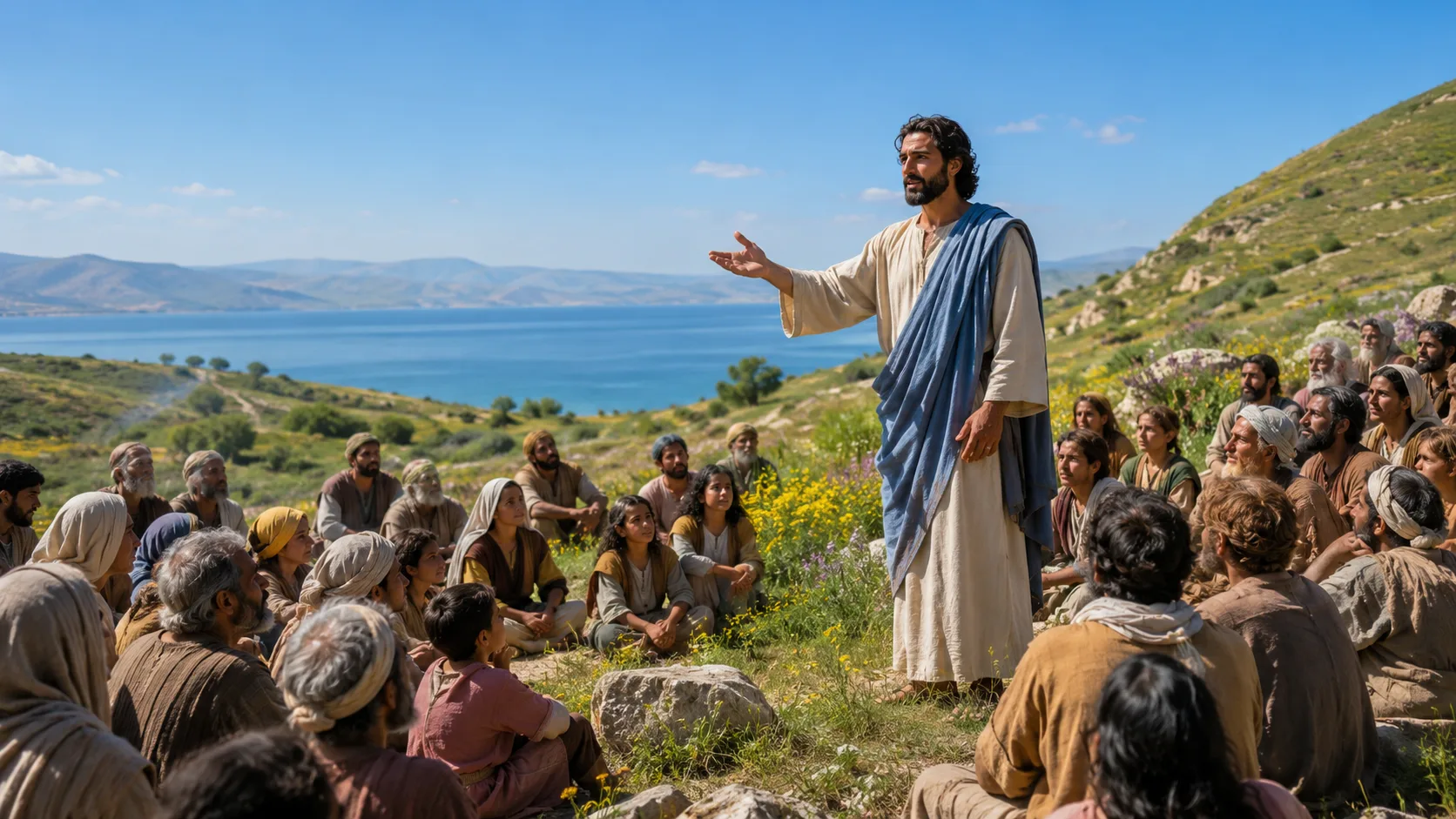
Jesus Christ
Son of God and Savior
Jesus Christ is the central figure of Christianity, the promised Messiah, and the Son of God who came to earth to reveal the Father, die for human sin, and offer eternal life through His resurrection.
Jesus Christ stands as the supreme focal point of the biblical narrative, fulfilling centuries of Old Testament prophecies concerning the coming Redeemer. Conceived by the Holy Spirit and born of the virgin Mary, Jesus represents the Incarnation—God becoming flesh to dwell among humanity. His public ministry launched a radical movement of love, grace, and truth that fundamentally transformed the religious landscape of first-century Judea and eventually the entire world.
Throughout His life on earth, Jesus demonstrated total obedience to the Father's will, modeling a life of perfect holiness, profound humility, and radical compassion. He chose twelve ordinary men as disciples, teaching them the mysteries of the Kingdom of God while healing the sick, restoring sight to the blind, and raising the dead. His authoritative teachings challenged the legalistic religious establishments of His day and extended God's covenant promises to all people.
The pinnacle of Jesus' earthly mission was accomplished on the cross of Calvary, where He willingly laid down His life as a flawless sacrifice to pay the penalty for human sin. Three days after His burial, He conquered death through a physical resurrection, proving His divine identity and securing eternal redemption for all who believe in Him. Having ascended back to the right hand of the Father, Jesus remains the living Lord, the singular Mediator between God and man, and the returning King of kings.
Name Meaning
The name Jesus is the Greek form of the Hebrew name Yeshua, which translates to "Yahweh saves" or "The Lord is salvation." This name was explicitly commanded by the angel Gabriel before His birth because it directly defined His ultimate mission on earth: to save His people from their sins.
The title Christ comes from the Greek word Christos, which translates the Hebrew term Mashiach (Messiah), meaning "The Anointed One." This title signifies His divine appointment as God's chosen Prophet, Priest, and King, setting Him apart to fulfill the ultimate purposes of God's redemptive plan.
Family Background and Lineage
1. A Royal and Prophetic Line
Jesus held the legal and biological right to the throne of King David, fulfilling the Davidic Covenant. His earthly lineage is documented through two separate genealogies in the Gospels, tracing His ancestry back through Judah, Abraham, and Adam to establish both His Jewish identity and His connection to all humanity.
2. Miraculous Conception
Jesus' conception was completely miraculous, bypassing human fatherhood entirely through the overshadowing power of the Holy Spirit upon Mary, a virgin betrothed to Joseph. Joseph, a righteous carpenter from the lineage of David, acted as Jesus' legal adoptive father on earth, protecting and raising Him in the town of Nazareth.
3. Relationship with John the Baptist
Elizabeth, the mother of John the Baptist, was a close relative of Mary, the mother of Jesus. John was born approximately six months before Jesus. Even before birth, John recognized the Messiah. When Mary visited Elizabeth, the unborn John leaped in Elizabeth's womb at the presence of the unborn Christ, demonstrating God's extraordinary purpose for his life.
Historical and Biblical Context
Jesus entered human history during the Pax Romana, a period when the Roman Empire held absolute geopolitical authority over the Mediterranean world, including the land of Israel. The Jewish people lived under foreign occupation, suffering under heavy economic taxation, social unrest, and the puppet governance of Rome's appointed rulers like the Herodian dynasty.
Spiritually, the nation was divided into various competitive religious and political sects, including the Pharisees, Sadducees, and Zealots. Legalism, political ambition, and religious hypocrisy dominated the spiritual landscape, leaving the common people spiritually weary. It was into this tense, expectant atmosphere that Jesus arrived, offering a spiritual Kingdom that defied both Roman power and Jewish religious corruption.
God's Calling
Jesus' entire existence on earth was the ultimate fulfillment of God's eternal plan, which was sovereignly ordained before the creation of the world and predicted by dozens of Old Testament prophets. He was called to be the ultimate sacrificial Lamb, the true High Priest, and the suffering Servant spoken of by the prophet Isaiah.
His life was entirely driven by a divine mandate to declare the arrival of God's Kingdom, to seek and save the lost, and to give His life as a ransom for many. Every miracle He performed and every word He spoke was done in perfect alignment with the timing and instructions given to Him by God the Father.
Major Roles
1. The Savior and Redeemer
Jesus accomplished the ultimate work of salvation by taking the sins of humanity upon Himself on the cross, offering forgiveness to all who believe.
2. The Great Teacher
He taught with unprecedented authority, using parables and direct commands to re-establish the true spiritual intent of God's law.
3. The Ultimate High Priest
Jesus serves as the permanent Mediator between God and humanity, offering His own blood as the final sacrifice for sin.
4. The King of Kings
He is the sovereign Ruler of an eternal, spiritual Kingdom that will reach its absolute fulfillment upon His eventual return.
5. The Son of God
He is the second person of the Trinity, existing as the perfect visible representation of the invisible God.
Appearance and Lifestyle
Jesus lived a simple, modest lifestyle as an itinerant teacher, relying on hospitality and the support of His followers as He traveled from town to town. He did not possess wealth, land, or a permanent home during His years of active public ministry, choosing instead to fully identify with the humble circumstances of the common people.
Scripture indicates that His physical appearance was that of an ordinary first-century Jewish man, possessing no unusual outward beauty or physical characteristics to attract people to Him. His power and appeal came entirely from His words, His holy character, and the divine authority that backed His ministry.
Character Traits
1. Unconditional Love
Jesus consistently demonstrated a deep, self-sacrificial love for humanity, willingly interacting with societal outcasts, sinners, and the broken.
2. Absolute Holiness
He lived a completely sinless life, successfully resisting every form of temptation and maintaining perfect moral purity.
3. Profound Humility
Despite His divine status, He chose to serve others rather than be served, even performing the menial task of washing His disciples' feet.
4. Righteous Indignation
He displayed a fierce passion for God's truth, boldly confronting religious hypocrisy and the exploitation of the poor.
5. Perfect Obedience
Jesus submitted His personal desires entirely to the will of His Father, even when it meant enduring the agony of the cross.
Major Life Events
1. Virgin Birth
Born in a humble manger in Bethlehem, accompanied by angelic announcements to shepherds and the arrival of Magi.
2. Baptism in the Jordan
Baptized by John the Baptist to fulfill all righteousness, marked by the descent of the Holy Spirit and the audible approval of the Father.
3. Temptation in the Wilderness
Spent forty days fasting in the desert, systematically defeating Satan's temptations using the authority of Scripture.
4. Public Ministry and Miracles
Traveled throughout Israel preaching the Gospel, turning water into wine, feeding thousands, calming storms, and healing incurable conditions.
5. The Transfiguration
Revealed His glorious divine nature on a mountain before Peter, James, and John, appearing alongside Moses and Elijah.
6. Crucifixion and Death
Arrested in Gethsemane, unjustly condemned by religious and Roman trials, and crucified on Calvary to pay for human sin.
7. Resurrection and Ascension
Rose physically from the dead on the third day, appeared to hundreds of witnesses over forty days, and ascended visibly into heaven.
Major Relationships
Mary and Joseph: His earthly parents who protected, raised, and nurtured Him throughout His childhood years in Nazareth.
The Twelve Disciples: His closest companions whom He personally selected, trained, and commissioned to carry His message to the world.
John the Baptist: His cousin and prophetic forerunner who recognized Jesus' identity and formally introduced Him to Israel.
Mary, Martha, and Lazarus: A family of close friends in Bethany with whom Jesus shared deep affection and whose home He frequently visited.
Pontius Pilate and Religious Leaders: The political and religious authorities who opposed His ministry and conspired to orchestrate His execution.
Key Teachings
Jesus' preaching emphasized:
Genuine repentance and belief in the Gospel
The arrival and nature of the Kingdom of God
Loving God completely and loving one's neighbor as oneself
Humility, forgiveness, and secret acts of righteousness
The danger of religious hypocrisy and material greed
Eternal life secured exclusively through faith in Him
His future return, the final judgment, and the renewal of creation
Important Biblical Passages
Isaiah 9:6-7 - Prophetic announcement of the birth and eternal reign of the Messiah.
Matthew 5-7 - The Sermon on the Mount, outlining the core ethics and values of the Kingdom of God.
Luke 2 - The detailed historical narrative of the birth of Jesus in Bethlehem.
John 1 - The theological explanation of Jesus as the eternal Word who became flesh.
John 3:16 - The central summary of God's love and the plan of salvation through His Son.
Philippians 2:5-11 - A profound description of Christ's humility, incarnation, death, and ultimate exaltation.
Revelation 19 - The prophetic vision of Jesus Christ returning in glory as triumphant Lord.
Legacy and Impact
The earthly life of Jesus Christ divided human history into two distinct eras and laid the foundation for the global Christian faith. His teachings revolutionized human concepts of morality, justice, human dignity, and love, inspiring countless charitable movements, educational institutions, and societal reforms over the past two millennia.
Beyond cultural and social change, His primary legacy is the establishment of a living, global community of believers who possess direct access to God. Through His death and resurrection, He broke the power of sin and death, offering a path to eternal reconciliation with God. Millions of lives across every generation continue to be radically transformed by the personal experience of His grace, presence, and saving power.
Symbolism
The Cross: Represents the supreme sacrifice, the payment for sin, and the reconciliation between God and humanity.
The Lamb: Symbolizes His innocence, purity, and role as the ultimate sacrificial offering for the sins of the world.
The Lion of Judah: Represents His royal lineage, sovereign authority, power, and ultimate victory over evil.
The Vine: Symbolizes Jesus as the source of spiritual life, nourishment, and fruitfulness for His followers.
Living Water and Bread of Life: Represent His ability to fully satisfy the deepest spiritual hunger and thirst of the human soul.
Extra-Biblical References
First-century and second-century historical records provide compelling validation of Jesus' existence outside the biblical narrative. The Jewish historian Flavius Josephus references Jesus in his Antiquities of the Jews, noting His reputation as a wise teacher, His execution under Pilate, and the ongoing movement of His followers. Roman historians Tacitus and Suetonius also mention Christ and the early Christian movement within their documentations of imperial Roman history.
These secular historical accounts, alongside early rabbinic writings, confirm that Jesus was a real historical figure who lived in Judea, gained a massive following, was crucified under Roman authority, and inspired a resilient movement that rapidly spread throughout the ancient world.
Lessons from Jesus' Life
True greatness is demonstrated through serving others.
Temptation can be successfully defeated through the power of God's Word.
God values the outcasts, the broken, and the humble over the proud.
Suffering can be part of fulfilling a greater divine purpose.
Forgiveness should be extended unconditionally to those who wrong us.
A life of regular, intimate prayer is essential for spiritual endurance.
Death does not have the final say for those who belong to God.
