
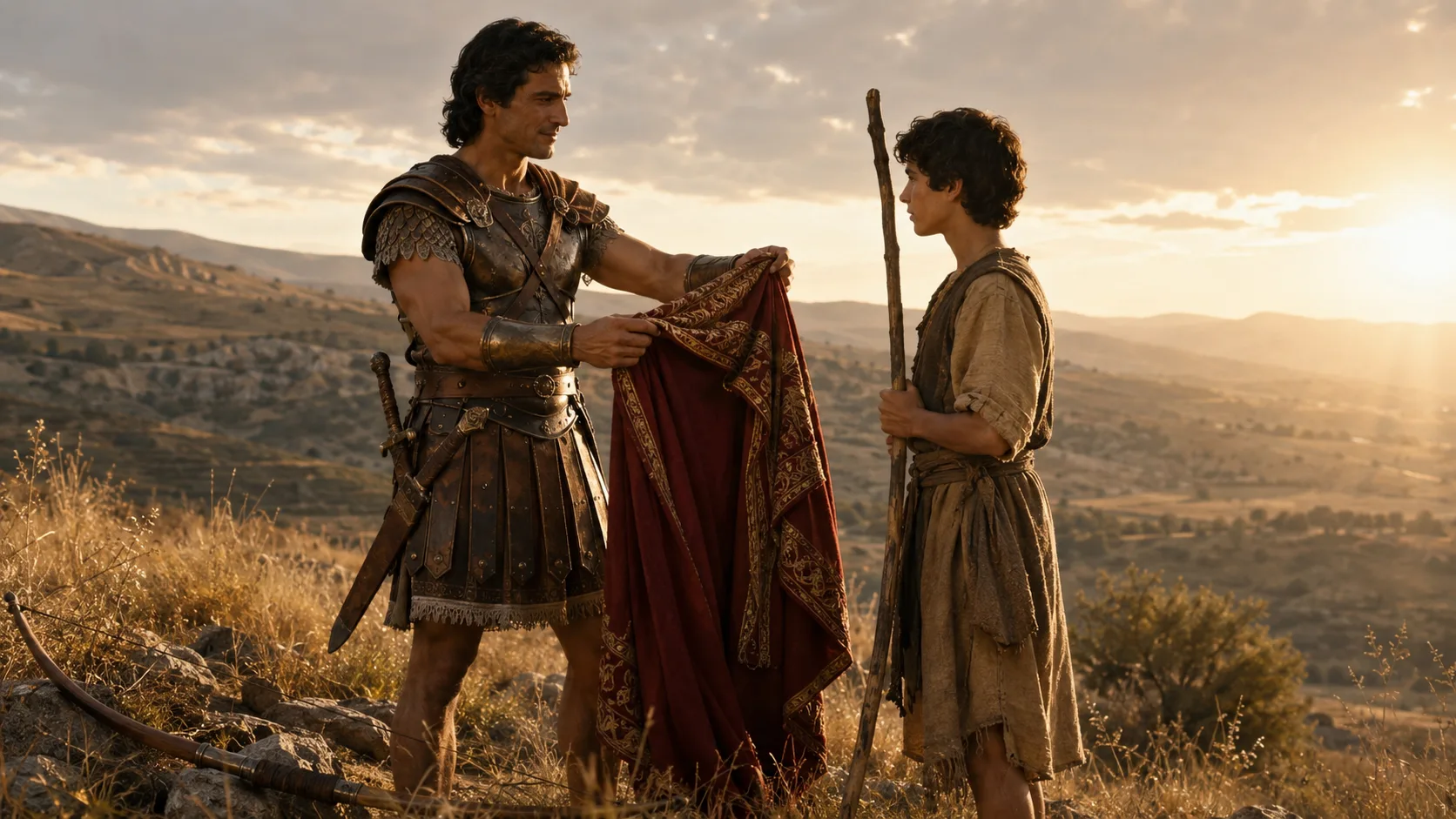
Jonathan
Faithful friend of David
Jonathan was a valiant warrior and the crown prince of Israel who willingly surrendered his right to the throne out of devotion to God's will and an unparalleled covenant of friendship with David.
Jonathan stands as one of the most compelling and heroic figures of the Old Testament narrative, representing the very best of Israelite nobility and unshakeable faith. As the eldest son of King Saul, he was the natural heir to the throne of Israel, yet he willingly forfeited his royal destiny out of absolute loyalty to God's chosen successor, David. His life was characterized by extraordinary military bravery, unwavering integrity, and a profound covenant of friendship that transcends time as the ultimate biblical model of selfless love.
Throughout his military career, Jonathan demonstrated a fearless reliance on God rather than numerical superiority or advanced weaponry. This was most famously displayed when he and his armor-bearer launched a daring two-man assault against a heavily fortified Philistine garrison, trusting entirely in divine deliverance. However, it was his relationship with David that defined his legacy. Recognizing God's anointing upon the young shepherd, Jonathan chose to protect his friend from the murderous jealousy of his own father, King Saul, at great personal risk.
Jonathan's life ended tragically on the battlefield of Mount Gilboa, fighting alongside his father against the Philistine armies. Though his earthly life was cut short and he never wore the crown, his legacy lived on through David's enduring love for him and the kindness David later extended to Jonathan's crippled son, Mephibosheth. Jonathan remains a powerful testament to the beauty of placing God's will and true friendship above personal ambition.
Name Meaning
The name Jonathan is the English translation of the Hebrew name Yehonatan or Yonatan, which beautifully translates to "Yahweh has given" or "Gift of God." This name perfectly encapsulates his role in the biblical narrative, as he was truly a divine gift of protection, encouragement, and friendship to David during the darkest and most dangerous periods of David's life.
Family Background and Lineage
1. Royal Heritage
As the firstborn son of Saul, Israel's first king, Jonathan was born into a position of supreme privilege and expectation. He was a prominent member of the tribe of Benjamin, a tribe renowned for its fierce warriors and skilled archers, a tradition Jonathan thoroughly upheld.
2. A Complicated Father-Son Dynamic
Jonathan loved and respected his father, faithfully serving him in military campaigns until the very end. However, he was completely opposed to Saul's descent into paranoia and his unrighteous obsession with killing David. This created immense tension, forcing Jonathan to navigate the agonizing space between honoring his earthly father and submitting to his Heavenly Father's will.
3. The Line Continued Through Mephibosheth
Following Jonathan's death, his royal bloodline was preserved through his son Mephibosheth, who was crippled in both feet during a hasty escape. Years later, King David restored Saul's lands to Mephibosheth and gave him a permanent seat at the royal table, entirely honoring his covenant with Jonathan.
Historical and Biblical Context
Jonathan lived during the tumultuous transition period when Israel shifted from a loose confederation governed by judges to a centralized monarchy. The nation was under constant, crippling oppression from the Philistines, who held a monopoly on iron-making and strictly disarmed the Israelites.
Israel's spiritual state was equally fragile. Saul's reign began with promise but quickly deteriorated due to his repeated disobedience to God's commands. As God's Spirit departed from Saul and rested upon David, the royal court became a place of political instability and extreme danger. Jonathan served as the crucial moral and spiritual bridge between the rejected house of Saul and the newly anointed house of David.
God's Calling
Jonathan's unique calling was not to be the king, but to be the kingmaker and protector. While human tradition dictated that he fiercely defend his right to the throne, God's calling required him to willingly step aside and facilitate the rise of another. He was tasked with discerning God's spirit resting upon David and acting as a divine shield to ensure David survived Saul's assassination attempts.
His life was driven by a deep spiritual clarity. He understood that God's sovereign plans were greater than dynastic succession, and his ultimate calling was to submit gracefully to a divine decree that cost him his own earthly kingdom.
Major Roles
1. The Fearless Commander
Jonathan was a brilliant and courageous military leader who inspired immense loyalty among his troops and regularly initiated successful strikes against occupying Philistine forces.
2. The Loyal Friend
He formed a soul-deep covenant with David, establishing the definitive biblical standard for platonic, brotherly love that prioritizes the welfare of the other above all else.
3. The Peacemaker
Jonathan frequently risked his own life and standing to act as a mediator between an enraged King Saul and a fleeing David, constantly attempting to advocate for David's innocence.
Appearance and Lifestyle
As the crown prince of Israel, Jonathan would have lived in the royal residence at Gibeah, enjoying the privileges of royalty. However, the biblical text primarily depicts him in the rugged environment of military encampments and battlefields.
Unlike the majority of the Israelite army, who were forced to fight with farming tools, Jonathan was fully armed with an iron sword, a bow, and royal armor. He wore a princely robe that signified his status as heir apparent. His lifestyle was that of a highly disciplined, active warrior who was accustomed to traversing difficult terrain and enduring the harsh realities of ancient warfare.
Character Traits
1. Selfless Devotion
Jonathan exhibited a complete lack of jealousy or toxic ambition, gladly giving up his inherent right to rule Israel out of love for David and reverence for God.
2. Courageous Faith
He did not rely on military mathematics but believed firmly that God could deliver Israel "by many or by few," leading to astonishing acts of battlefield bravery.
3. Spiritual Discernment
While Saul was blinded by paranoia, Jonathan possessed the spiritual clarity to recognize God's anointing on David and align himself with God's ultimate purpose.
4. Integrity
He consistently spoke the truth to power, defending David's righteous character directly to King Saul even when Saul threw a spear at his own son in a fit of rage.
Major Life Events
1. The Battle of Michmash
Jonathan and his young armor-bearer secretly left the Israelite camp to assault a Philistine outpost, trusting God for a sign. Their victorious strike triggered a panic among the enemy and led to a massive Israelite victory.
2. The Covenant with David
Following David's victory over Goliath, Jonathan's soul was knit to David's. He stripped off his royal robe, his armor, his sword, and his bow, giving them to David as a profound symbol of transferring the right of succession.
3. Interceding with Saul
Jonathan successfully reasoned with his father on several occasions, temporarily cooling Saul's murderous rage and restoring David to the royal court for a season.
4. The Arrow Warning in the Field
When Saul's intent to kill David became permanent, Jonathan met David in a field and used a predetermined signal with a bow and three arrows to warn his friend to flee into exile, culminating in a tearful final parting.
5. Death on Mount Gilboa
Despite knowing the kingdom would ultimately go to David, Jonathan remained loyal to his father and his nation, fighting fiercely against the Philistines until he was slain alongside Saul on the slopes of Mount Gilboa.
Major Relationships
David: His closest companion and covenant brother, for whom he sacrificed his earthly future and provided physical and spiritual salvation.
King Saul: His deeply flawed father, whom Jonathan honored by serving in his army, yet bravely defied when Saul's commands violated God's righteousness.
His Armor-Bearer: A loyal young soldier who shared Jonathan's radical faith and willingly followed him into an impossible two-man battle at Michmash.
Mephibosheth: His physically disabled son, who became the living recipient of the covenant grace Jonathan had secured with King David.
Key Teachings
Jonathan's life demonstrated:
True friendship requires sacrificial love and placing others above oneself
Spiritual discernment means recognizing God's will even when it costs you personally
Real courage relies entirely on the limitless power of God rather than human numbers
Loyalty to God and righteousness must supersede toxic family allegiances
Generosity is expressed by giving up our most prized possessions for the sake of others
God honors covenants of love and faithfulness across generations
Important Biblical Passages
1 Samuel 14:6 - Jonathan's declaration of faith to his armor-bearer that God can save by many or by few.
1 Samuel 18:1-4 - The forging of the deep covenant of friendship between Jonathan and David, sealed with the giving of the royal robe.
1 Samuel 20 - The detailed narrative of the secret meeting and the warning of the arrows to save David from Saul's wrath.
2 Samuel 1:25-26 - David's agonizing and beautiful poetic lament over the death of Jonathan on the battlefield.
Legacy and Impact
Jonathan's legacy rests securely in his position as the ultimate friend. For thousands of years, his relationship with David has been held up as the gold standard for brotherly love, loyalty, and covenant faithfulness. He proved that true greatness is not always found in sitting on a throne, but in gracefully facilitating God's plan for someone else.
His actions literally preserved the lineage of David, through which Jesus Christ would eventually be born. By saving David's life, Jonathan played an essential, irreplaceable role in the redemptive history of the world. He shows humanity that a life marked by integrity, humility, and sacrificial love outshines the glory of any earthly crown.
Symbolism
The Royal Robe: Represents the willing surrender of his royal inheritance, his identity as crown prince, and his submission to David's anointed kingship.
The Bow and Weapons: Symbolize his martial strength, his protective nature, and his commitment to use his power to defend God's chosen king.
The Three Arrows: Represent loyal friendship, divine warning, and the painful necessity of parting ways to preserve life.
Wild Honey: Symbolizes the sudden renewal of strength, clear vision, and the physical provision of God in the midst of exhausting spiritual warfare.
Extra-Biblical References
Historical details surrounding the time of Jonathan are supported by archaeological discoveries relating to the Philistine occupation of the Levant during the Iron Age, confirming the technological disparity between the Philistines and Israelites mentioned in the text. Furthermore, the first-century Jewish historian Flavius Josephus expands upon Jonathan's bravery and his profound friendship with David in his comprehensive work, Antiquities of the Jews, validating Jonathan's historical standing as a celebrated hero and a noble prince within ancient Jewish tradition.
Lessons from Jonathan's Life
True friendship is defined by what you are willing to give up for another person.
Submission to God's sovereign plan is infinitely more important than personal ambition or birthright.
Courage is not the absence of fear but the presence of faith in God's ability to deliver.
We can honor our family members while still refusing to participate in their destructive or sinful actions.
Even in a tragic death a righteous life leaves an enduring legacy that outlasts earthly empires.
