
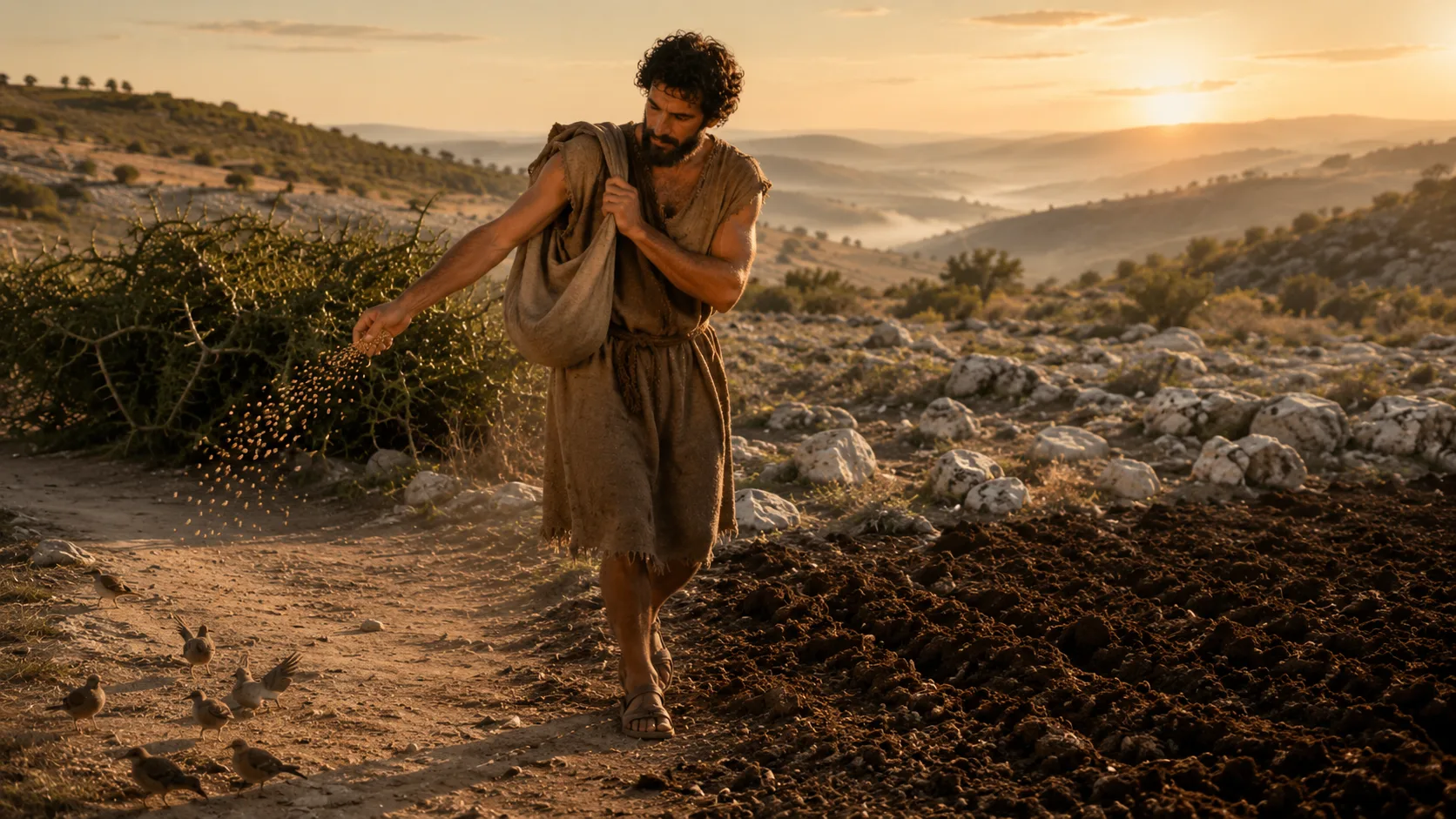
The Parable of the Sower
The Four Soils and the Condition of the Human Heart
The Parable of the Sower is a central New Testament teaching that uses the metaphor of a farmer scattering seed across four different types of soil to illustrate how different people receive, process, and respond to the Word of God.
The Parable of the Sower stands as one of the most foundational and universally recognized teachings of Jesus Christ, marking a critical shift in His public ministry. First delivered to a massive crowd gathered along the shores of the Sea of Galilee, this simple agricultural illustration serves as a profound spiritual mirror. By using the everyday imagery of a farmer scattering seed, Jesus revealed the mysteries of the Kingdom of God and diagnosed the varied conditions of the human heart in response to divine truth.
Throughout His ministry, Jesus used parables to simultaneously reveal truth to the spiritually hungry and conceal it from those with hardened, cynical hearts. When His disciples asked Him why He spoke to the crowds in parables, Jesus explained that this particular story was the key to understanding all other parables. Without grasping how the heart receives the Word of God, one cannot fully comprehend the dynamics of spiritual growth and transformation in the Kingdom.
The pinnacle of this teaching is found in its deeply personal application. Jesus shifts the focus away from the skill of the sower and the quality of the seed, placing the ultimate responsibility on the soil itself. By analyzing the four distinct environments where the seed lands, Jesus challenges every listener to examine their own spiritual health, spiritual maturity, and capacity to produce a crop of lasting righteousness.
Metaphorical Meanings
The Sower and the Seed
The Sower refers to Jesus Christ Himself, as well as His apostles, disciples, and anyone who faithfully proclaims the truth of God's Word to others. The sower does not discriminate or selectively plant; instead, he scatters the seed generously and universally, ensuring that every type of ground has an opportunity to receive it.
The Seed represents the Word of God, specifically the Gospel message of the Kingdom of salvation. The seed contains inherent, life-giving power and possesses the genetic potential to produce a miraculous harvest, but its ultimate success is entirely dependent on the quality of the ground where it is planted.
Detailed Breakdown of the Four Soils
1. The Pathway (The Hardened Heart)
This represents the hard-packed soil of a heavily trafficked dirt road. Because the ground is completely impenetrable, the seed cannot sink below the surface, leaving it exposed to the elements. Jesus explains that this represents a person who hears the word of the Kingdom but does not understand or receive it. Consequently, the devil immediately comes and snatches away what was sown in their heart to prevent them from believing and being saved.
2. The Rocky Ground (The Shallow Heart)
This refers to a thin layer of soil resting directly on top of a solid shelf of limestone. Because the soil is warm and shallow, the seed germinates rapidly, but the roots have no depth to access moisture. When the hot sun rises, the young plant quickly withers and dies. Jesus explains that this represents someone who receives the message with immediate joy, but because they have no deep roots, they only endure for a short time. When trouble, trial, or persecution arises because of the Word, they quickly fall away.
3. The Thorny Ground (The Distracted Heart)
This represents soil that is fertile but infested with wild thorns and weeds. The seed grows successfully, but the aggressive weeds compete for resources, blocking out sunlight and stealing vital nutrients. Jesus explains that this represents a person who hears the Word, but the worries of this life, the deceitfulness of wealth, and the desire for other things choke the message, making it completely unfruitful.
4. The Good Soil (The Fruitful Heart)
This represents deep, rich, cultivated ground that has been prepared to receive nourishment. The seed sinks deep into the earth, establishes strong roots, grows without competition, and produces a massive, healthy harvest. Jesus explains that this represents the person who hears the Word, fully understands it, holds it fast in an honest and good heart, and patiently produces fruit yielding thirty, sixty, or even a hundred times what was originally sown.
Historical and Agricultural Context
In first-century Israel, agriculture was the primary means of survival for the vast majority of the population. Fields in the Galilean region were not perfectly manicured modern farms; instead, they were characterized by overlapping patches of fertile soil, rocky limestone outcroppings, ancient footpaths used by travelers, and aggressive thorn bushes like the Syrian Christ-thorn.
Farmers of this era practiced a method of farming where they scattered seed by hand across the unplowed landscape before returning to plow the field to cover the seed. This explains why the sower's seed landed on paths and thorn-infested patches that had not yet been fully cleared or cultivated. Jesus spoke directly to this familiar reality, utilizing the daily labors of His audience to convey deep, eternal spiritual principles that anyone could easily visualize.
Purpose of Using Parables
Jesus' decision to use parables marked a distinct transition in His teaching style, designed to separate genuine seekers from casual observers. Following growing opposition from religious authorities, parables served as a sorting mechanism. To those with a humble desire for truth, the stories became windows into the Kingdom; to those who were prideful, legalistic, or intellectually arrogant, the stories remained confusing riddles.
By using parables, Jesus fulfilled the prophecy of Isaiah, which warned that people would be ever hearing but never understanding, and ever seeing but never perceiving. The parables protected sacred truths from mockery while inviting sincere disciples to press deeper into relationship with Him to discover the hidden meanings of His words.
Major Roles
The Evangelistic Framework
The parable provides a universal diagnostic framework for evangelism, explaining why different people react so differently to the exact same message.
The Guide for Self-Examination
It serves as a personal spiritual checkup, prompting believers to evaluate which type of soil represents their current heart condition.
The Encouragement for Preachers
It reassures spiritual leaders and teachers that when people reject the Gospel, the fault lies with the receptivity of the hearer rather than the power of the message.
The Call to Ultimate Fruitfulness
It establishes fruitfulness as the true metric of saving faith, distinguishing superficial conversions from genuine discipleship.
The Sower's Lifestyle and Methods
The ancient Jewish sower was a figure of patience, hard work, and deep trust. He carried his seeds in a heavy leather bag draped over his shoulder or gathered up in his outer tunic. As he walked slowly across the field, he threw the seeds using a rhythmic, sweeping arm motion to ensure even distribution.
This work required immense faith, as the farmer had to willingly cast valuable grain onto the ground, leaving it vulnerable to birds, weather, and wild animals, while waiting months for the autumn and spring rains to bring forth a harvest. This reflects the patient work of God's servants, who cast the truth of the Gospel into a hostile world, relying entirely on the Holy Spirit to bring about spiritual life.
Character Traits of the Soils
1. Hardness
The pathway is marked by indifference, intellectual pride, and closed-mindedness, refusing to allow God's truth to penetrate the surface.
2. Emotional Shallowness
The rocky ground represents emotional excitability without true commitment, characterized by a desire for blessings without any willingness to endure suffering.
3. Divided Loyalty
The thorny ground is defined by distraction, anxiety, and a divided heart that attempts to love both God and the pleasures of the world.
4. Integrity and Endurance
The good soil represents humility, a teachable spirit, deep reflection, and patient endurance that produces lasting spiritual fruit.
Narrative Breakdown of the Event
1. The Gathering by the Lake
Jesus leaves a house and sits by the Sea of Galilee, where such a massive crowd gathers around Him that He is forced to get into a boat and push off from the shore to teach them.
2. The Proclamation of the Parable
Standing in the boat, Jesus uses the natural acoustic amplification of the water to preach the story of the sower to the crowds sitting on the hillside.
3. The Private Query
After the crowds disperse, the twelve disciples and His close followers gather around Jesus in private, asking Him to explain the meaning and purpose of the parable.
4. The Divine Explanation
Jesus commends the disciples for their desire to know the secrets of the Kingdom and provides a detailed, point-by-point explanation of the four soils.
Key Biblical Characters Involved
Jesus Christ: The master teacher who delivered the parable from a boat and later revealed its deep spiritual meaning to His followers.
The Disciples: The inner circle of followers who sought further clarification, demonstrating the humble, seeking heart that characterizes good soil.
The Crowds: The diverse mass of listeners who heard the story outwardly, representing a mixture of all four types of spiritual receptivity.
Key Teachings
The Word Must Penetrate the Heart
Mere physical hearing is not enough; the truth of God must be deeply understood, internalised, and embraced for transformation to occur.
Trials Reveal Our Spiritual Depth
Persecution and difficulty are not signs of God's absence; they are spiritual tests that reveal whether our roots are deep enough to sustain us.
Worldliness Chokes Spiritual Life
The subtle distractions of worry, money, and comfort are just as deadly to spiritual survival as outright rebellion or persecution.
True Faith Always Produces Fruit
The definitive proof of a transformed life is the visible production of spiritual fruit, characterized by love, obedience, and mature Christian character.
Important Biblical Passages
Matthew 13:3-9 - The initial telling of the Parable of the Sower to the massive crowds gathered by the Sea of Galilee.
Matthew 13:18-23 - Jesus' personal, detailed explanation of the spiritual meaning behind each of the four soils.
Mark 4:13 - Jesus' statement emphasizing that understanding this parable is the essential key to unlocking all other parables.
Luke 8:15 - Luke's unique recording of the good soil, describing it as those who hold the Word fast in an honest and good heart and bear fruit with patience.
Legacy and Impact
The Parable of the Sower has profoundly shaped the missionary and evangelistic strategies of the global Christian Church for two thousand years. It serves as the primary biblical basis for understanding the challenges of ministry, teaching believers to anticipate diverse responses and to remain faithful in scattering the seed regardless of the outcome.
In addition, the parable has left a permanent mark on literature, psychology, and culture, popularizing the concept of "having deep roots" or "falling on fertile ground." It continues to serve as an ongoing call to self-examination, warning every generation against the modern thorns of consumerism and distraction while inspiring a standard of deep, fruitful, and patient Christian living.
Symbolism
The Birds: Represent Satan and his demonic forces who actively work to steal God's truth from hardened, unreceptive hearts.
The Scorching Sun: Symbolizes the trials, persecutions, and difficulties of life that test the depth and authenticity of a person's faith.
The Thorns: Represent the suffocating pressure of daily anxieties, the empty promises of wealth, and the pursuit of physical pleasures.
The Harvest: Symbolizes the supernatural results of a life lived in obedience to God, resulting in Christlike character and the salvation of others.
Historical Agricultural Parallels
Secular historical accounts of ancient Mediterranean farming techniques validate the precise details of Jesus' parable. Roman agricultural writers like Varro and Columella documented the extensive challenges that ancient farmers faced with invasive weeds, shallow limestone layers, and the persistent problem of birds devouring freshly scattered seeds before they could be plowed under.
These writings confirm that Jesus was not describing an idealized or fictional scenario, but rather a highly accurate, gritty, and relatable picture of first-century Galilean life that carried immediate credibility with His original listeners.
Lessons from the Parable of the Sower
We must actively guard our hearts against spiritual hardness to ensure God's Word can always penetrate our lives
True spiritual growth requires us to build deep roots through daily prayer and study to survive the inevitable storms of life
We must intentionally identify and pull up the spiritual thorns of worry and greed before they choke our relationship with God
God does not expect the exact same quantity of fruit from everyone, but He does expect every healthy tree to be fruitful
The power to change a life resides entirely in the Word of God, while our role is simply to keep our hearts receptive
We should never be discouraged by immediate rejections of the Gospel, as the sower's job is to sow while God brings the growth
